12 Jul 2007

Libeskind and Embodied Justice

I am always interested in where people come from and I was fascinated to hear world famous architect Daniel Libeskind, at a Shape East event in Cambridge this evening, discoursing on his youth in Poland, where he was born in 1946. He described being taken into the centre of Warsaw by his parents where there was only one tall building, which was the HQ of the Communist Party. It gave him a feeling of dread.

The connection with tall buildings and power has stuck with him. He doesn’t mind tall buildings, it’s totalitarianism that upsets him. He said he has turned down project after project in China because he doesn’t like the regime. He’d much rather tussle with the problems of tough assignments, none more so than his designs for Ground Zero in New York. His original design for the Freedom Tower was to have been 1776 feet tall, to reflect the year of American Independence. He calls it embodied justice.

Incidentally, by my reckoning he looks rather like Elton John, but he talks more like Woody Allen. That alone makes him quite a draw. He doesn’t appear to have got his first commission until the age of 43 but has signed off over 25 major projects since. In terms of global impact, he is now only rivalled by Frank Gehry. They have a lot in common but, whilst Gehry is known for his impossible curves, Libeskind is all about unfeasible angles and shards of light. They have both achieved fame and success through designing iconographic museums, which then went on to be commercially successful. Now he is inundated with requests from developers who want to build shopping malls that look like off-the-wall museums, hoping to add cultural significance to the shopping experience.

11 Jul 2007

Anyone for an air source heat pump?

This man is Peter Ferguson and he'd like to sell you one. He owns and runs Trianco, the Sheffield-based, metal bashing oil-fired boiler maker. I spent a couple of hours with him on Monday, listening to his tale and sharing his dreams and aspirations.

Oil boilers are a mature market. There are perhaps a million of them dotted around the country, mostly in out of the way locations where mains gas can’t reach. Each year, 60,000-odd new ones get installed, mostly as replacements. Trianco have a slug of this market, around 10%, but it’s not growing. Oil boilers, just like solid fuel boilers before them, would seem to be yesterday’s technology. Even with the recent move over to condensing boilers, there doesn’t seem to be much mileage left here for long term growth plans.

The question is what will replace them. The world and their aunt are all harping on about renewables and carbon-free or carbon-lite power systems. With climate change slowly moving centre stage, it’s hard not to conclude that this is where the future lies. But there is still a lot of doubt as to which of the new technologies will succeed and which will fall by the wayside.

Ferguson reckons he’s spotted a market gap here and thinks that Air Source Heat Pumps (ASHP) may just be the next big thing. ASHP are the smaller and lesser known relative of the ground source heat pump (GSHP) which has, in contrast, had quite a lot of attention in recent years. ASHP differs from GSHP in three crucial respects:
• it doesn’t require digging up the garden and rolling out 100s of metres of tubing
• instead it works by taking heat out of the air
• it’s cheap compared to GSHP and to all the other green power systems.

To date, people have thought of heat pumps primarily as space heating devices. Ferguson’s Eureka moment came when he saw that it would be beneficial to position ASHP against solar thermal panels, as an alternative method of delivering hot water for the tap. Instead of spending maybe £3,000 or more installing solar panels on your roof, which, if you were lucky, would deliver just over half your hot water requirements throughout the year, here is a solution which would cost half this price and which would provide all your hot water. Because it’s a heat pump, it delivers around three times the energy it requires to run it, so potentially you could draw off say your 4,000kWh of hot water (typical of a modern household of four) for an outlay of just 1250kWh, cost around £100 a year.

He is particularly interested in the small ASHP units, which are rated at 3kW output. The one in the photo I took is the larger 5kW one, so you can imagine that the 3kW one is almost half this size. Crucially, it is small enough to fit through the average loft hatch, and this in itself opens up a whole new market for heat pumps — small houses without gardens. The unit can get plumbed into the loft where the air temperature will, in any event, be a little higher than outdoors, and in about two hours a day it will be capable of delivering 150lits of hot water, enough for a couple of people. It’s not a renewable power source, as it uses electricity, but because the way heat pumps work, it will use about a third of the electricity an electric immersion heater would use, so it will deliver 6kWh of heat energy for just 2kWh of juice burned.

Will it catch on? Well, it may do. The one thing that makes Ferguson very bullish about his ActivAir heat pumps is that he can sell them for £695 + VAT. Compare that with solar panels (at around £2,500), or indeed any of the other renewable or carbon-lite technologies, and you can see that his ASHP units may well find a new market.

The downsides are that the units are a little on the noisy side to be happily operating indoors. And the recovery rate, the time taken to replenish your hot water cylinder, is rather slow. The 3kW unit would take over two hours to recover, as compared with 30 minutes for a similar-sized cylinder heated by a conventional boiler.

There is also the cost calculation to run through. Although ASHP will deliver three units the heat output for every one unit of electricity required to operate it, that electricity is always going to be more expensive than mains gas. And if the mains gas is a third of the price of mains electricity, then your cost saving vanishes. As it stands, mains gas is rather more expensive than this at the moment, but not by a lot, so the running cost saving is there, but only just. Unless of course you manage to run your ASHP unit on Economy 7, in which case it becomes very cheap to run indeed. But then you’d have it whirring away for a couple of hours every night whilst you slept. If you mounted it correctly, you wouldn’t hear a thing, but it would always be a concern that it could keep you awake.

Trianco’s ASHP units are available in larger sizes. As well as the 3kW output, there are 5kW, 7kW and 12kW. This largest size is capable of taking on GSHP as a whole house space heating solution. Many people feel that it’s got to be less efficient than GSHP because outside air temperatures are habitually lower than winter ground temperatures, but Ferguson’s units work at good efficiencies down to —3°C, which is about as cold as it gets in southern England these days. And at £1895, it is way cheaper than any GSHP unit I have come across.

At the moment, Ferguson is importing his ActivAir units from China, but has high hopes of bringing the metal bashing and assembly functions in house as sales demand rises. It’ll be fascinating to see whether he manages to establish ASHP as a serious contender for the future of home heating. It won’t be for a lack of trying.

10 Jul 2007

Eco Bollocks Award: Dept Communities and Local Govt


As part of its widespread review of our energy saving strategy, the government published a paper in November 2006 called the Review of Sustainability of Existing Buildings. It’s a critical issue both for national policy and for the homeowner seeking to reduce their fuel bills and their carbon footprint.

Buried within this document is a table, which lists 13 energy saving measures that can be carried out on existing homes, together with a breakdown of costs, payback periods and energy saving potential. It makes startling reading for anyone considering a house renovation. The most effective measure is listed as providing insulation for your hot water cylinder, at a cost of just £14 and an annual saving of £29: in contrast, the least effective thing you can do is switch from single glazing to double glazing, something which will cost you around £4,000 and will only save £41 a year.

However, as a guide to what to do, this table is horribly flawed and contains a number of glaring errors. The single worst of which is that the savings suggested are not cumulative: if you added together a basket of measures you might take to refurbish a house, the savings appearing in this table come to more than the total energy usage of the house before any renovation has taken place. Clearly that is a nonsense. For instance, whilst installing an A-rated boiler might just save you £168 a year if you took no other energy saving measures at all, this saving reduces dramatically when you insulate the loft, the walls, fit double glazing and draft proofing, not to mention providing a hot water cylinder with an insulated jacket. Whilst this might appear to be blindingly obvious, it appears to have escaped the attention of the authors of this report, who use this saving rate to calculate the potential for energy saving throughout the whole country, simply by multiplying the potential saving in each home by the number of homes without A-rated boilers, some 17 million.

It gets worse. There are some frankly unbelievable figures in here. The amount of saving from solid wall insulation (as opposed to cavity wall filling) is down at £380 a year. Seeing as the average gas bill for an average house (which this is supposed to be modelled on) is between £500 and £600 a year, which includes heating domestic hot water and cooking, as well a boiler loses (by not having that A-rated boiler, estimated at around £168, remember), they are claiming that you will virtually eliminate your space heating bills by applying solid wall insulation around your house. Writing as someone who once did this exercise, I can assure you that this will not happen!

The micro wind turbine appears in the table with a saving of £224 a year. I have no idea where this figure comes: even the very generous estimates provided to us by the manufacturers don’t suggest that a wind turbine can provide more than 1,000kWh of electricity a year, which is worth about £120 (if you have a particularly penal tariff!). Actual returns from micro wind turbines fitted are coming in at far less than this: indeed several have been fitted thus far that have yet to produce any electricity at all. So how the table manages to come up with a 10.5 year payback I have no idea.

It’s not much better with photovoltaic solar panels. The table suggest that for an outlay of £9844 (before grants), you can hope to make a saving of £212. That sort of money will buy you nearly 10m2 of panels which should, if you are lucky, produce around 1,000kWh per annum. To buy this at 9p/kWh would cost you £90, so unless you are buying electricity at a whopping 21.2p per hour it’s hard to see how you would obtain a saving of £212.

The ground source heat pump example isn’t any better. For a start, they are not really recommended in properties that aren’t already heavily insulated and have comparatively low heating demand, ideally delivered by underfloor heating. It’s not something you should consider powering a house with no loft insulation, no wall insulation and single glazing. No way. But the authors of this report are suggesting that it could be used in 17 million homes (that’s every one with a garden) and that it could save a tonne of carbon emissions in each one, saving the residents £368 on their gas bills. Phoey. Whilst ground source heat pumps have their place, and may reduce gas bills substantially, they do it by racking up rather large electricity bills instead (especially in uninsulated homes!). This seems to have completely escaped the report writers.

So please handle this information with care. I know it’s not intended to be guidance for the individual homeowner, but if it was accurate there is no reason why it shouldn’t be used as such. But it’s not accurate. Not at all. If that’s the standard of the advice the government is getting about this issue, then heaven help them in their drive towards a low carbon economy.

6 Jul 2007

How I became a Moisture Maven

When we built our house in 1992, ventilation was one of the things I knew next to nothing about. We just went along with the suggestions of our designer and business partner at the time, Robin Gomm, combined with the wisdom of our electrician. We went conventional, which meant that our windows came installed with trickle vents and our wet rooms had the standard extract fans installed.

Now I never liked those pesky trickle vents. It seemed to me that they either did nothing at all or they blew a gale through them. There didn’t seem to be much in between. Bit by bit, one at a time, I started closing them off — they are the type that has a hit and miss slider that enables you to close them. After a few years, they were all closed. It really didn’t seem to make any difference to the way the house felt or smelt.

Then one day about seven or eight years ago, the fan in the en-suite bathroom cut out. It has been strategically mounted in the ceiling directly above the shower, and it was connected to the outside via a duct going up through the attic above and out via a vent tile in the roof. Up until then, I had religiously turned the fan on everytime I took a shower and my first thought when it broke was “Must get that fixed at once.” But, of course, a fan in your ensuite bathroom isn’t exactly a life and death issue so I left it for a few weeks. And I watched to see what difference it made.

The answer was none at all. This is what set me thinking about ventilation, relative humidity levels and whether our present routines make sense. Here we had a fairly small, enclosed space, our ensuite bathroom, with no trickle vent open and no extract fan, and yet even in the depths of winter, there was no problem at all with excess humidity. Showers throw off a lot of water vapour and we typically find that the window and the mirror will mist up after a shower, but within a few minutes it’s all gone and everything appears to be normal once more. And having trickle vents open and fans on didn’t appear to make the demisting appreciably quicker.

At this point, I went out and bought some hygrometers. They were only simple little greenhouse-style ones, costing two or three quid, but they served my purpose. It turned out that the relative humidity levels in the house tended to settle at around 50% to 60% throughout most of the year. After a shower, the levels would rise to 80%, sometimes near 90%, but they would settle back down within fifteen or twenty minutes. If the door remained closed, it would stay humid much longer, but if the bathroom door was left open, the humid air would seem to mix with the dryer air and the normal humidity levels returned very quickly. All without any obvious ventilation at all.

But there was another unexpected consequence of my data logging. According to classic water vapour theory, the reason the inside of houses have a higher absolute humidity level than the great outdoors is because we live in them. We not only shower, but we breathe, sweat, cook and wash. We produce water vapour by the proverbial bucketload.

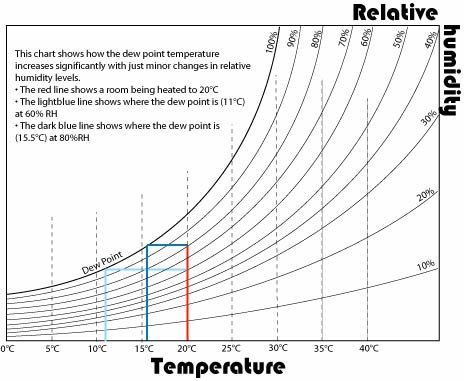
So if we are responsible for all this water vapour, it should stand to reason that if you take us away for a few days, the humidity levels in the house should fall back into equilibrium with outside. And by equilibrium, we are referring to a state where the vapour pressure indoors matches that outdoors. This would suggest that in winter, the indoor relative humidity levels should fall back to around 25% or 30%. Use the accompanying chart to work out the difference between absolute and relative humidity levels.

So what happens when we go on holiday or away for the weekend and remove the source of all this water vapour? Relative humidity indoors doesn't fall at all, it sticks at the 50% to 60% background level that occurs when we are in residence.

There must be some unanticipated processes at work here. It could be that our house is so badly built that it self-ventilates through the fabric and therefore my findings are irrelevant. But that wouldn’t explain why the humidity levels remain higher indoors than outside even when we are away. I suspect that it’s got a great deal to do with the moisture buffering idea that I have been going on about in recent posts, but moisture buffering is a hard thing to measure, so my theory has to remain untested. Bearing in mind that there is about 100 times more bound water in the structure and furnishings in a house than there will ever be free floating water vapour in the air, my guess is that there is a sort of natural evaporation/absorption rate inside a house, which is largely determined by temperature, the humidity and the moisture content of the surrounding materials, and that the materials are capable of altering their moisture content without us ever being aware of it. In short, the house acts a bit like a sponge, soaking up and giving off water as conditions dictate.

Only where you have bathrooms made up of entirely non-porous materials do you start to get problems with condensation. Or when you let the temperature of a room fall below dew point, somewhere around 12°C. Then you will start to see condensation and mould growth. If you keep the rooms reasonably warm and you have materials capable of absorbing excess moisture, then I don't think condensation is ever going to be a serious problem. Misting mirrors doesn’t count as serious.

I am not so stupid as to believe that my homemade experiments constitute serious scientific investigation, but they are interesting to my mind because they are reasonably consistent and they indicate that something is amiss with our conventional understanding of the issues. If my pet theory is right, then we are guilty of over-ventilating, in order to remove a suspected hazard (excess water vapour) which seems to be largely self-regulating. In the short term, this is not a subject that is likely to get heavily researched because there isn’t a product or group of products out there waiting to be sold. Unless someone comes up with one. Anyone for vapour permeable wall tiles?

5 Jul 2007

More on Polish Builders

When I last wrote about Polish bulders, it was mostly in glowing terms. However, I did add a warning note: Doubtless there will be a few Polish rip-off merchants and quite a few useless Polish builders, just as there are with all ethnic groups, in all walks of life.

As if to bear this out, an unhappy story comes to my attention today, also emanating from Edinburgh, although I think this is mere co-incidence.

The moral is this. Don’t suspend all your critical faculties just because the builder comes from Poland and looks to be cheap. Not everyone born in Poland is a saint. And, despite what my previous story was advocating, try not to pay cash upfront. I know it’s easier said than done, but most building horror stories have the phrase cash upfront somewhere in the telling of the tale.

3 Jul 2007

How should we Handle Humidity?

I still hear the old canard that 80% of our body weight is made up of water. I remember hearing it back at school and I’ve had it repeated to me by my children, so it feels like it’s still doing the rounds. Actually, that fount of all knowledge, Wikipedia, reckons it’s rather less, around 55% for men and 51% for women (more fat). I am not going to argue. It’s perhaps not 80% but it’s still a hell of a lot of water.

What you don’t so often hear — in fact just about never — is what proportion of your home is made up of water. I am not talking about water in the pipes and in the hot water cylinder and various tanks: I am referring to water bound up in the fabric of the house. There’s a surprising amount: nothing like the 50-odd% that exists in the human body but very possibly around 10% of the mass of a house will be made up of bound-water. Timber, for instance, has a moisture content which varies from as little as 5% (incredibly dry) up to over 30% (dripping wet), but often tends to settle down in a centrally heated house at around 10%. Masonry materials, even concrete, are hygroscopic to a surprising extent and can take on and release moisture according to conditions. You only have to drop a brick in a bucket of water to see the effect it has on its weight.

The fact is that a detached house, which can weigh anything between 50 and 200 tonnes, depending on size and construction methods (and that’s excluding all the foundations), could be holding as much as 10 tonnes of bound water within the walls, floors and roofing, and a lot more within the fixtures and fittings as well.

What does 10 tonnes of water look like? Due to the miracle of metricated measurements, 10 tonnes of water turns out to be 10m3 in volume, about the size of a small bedroom, or perhaps 70 bathfulls, if you prefer that. It also turns out to be 10,000litres, which is the amount of water a typical household uses in about two weeks, or around 1500 flushes on a 6lt low flush toilet.

All this bound-water doesn’t have to stay bound. When conditions dictate otherwise, it can either absorb more water or it can release water via evaporation. This does rather depend on the surfaces surrounding the materials: some are very water permeable, others are not. Exactly how much water transfers between the solids in the house and the air in and around it is unknown - it’s never been measured, as far as I know – but it’s likely to be fairly substantial. If it amounted to a change of just 1% of water by weight, we would be talking about 100 litres of water.

Now on a typical day in the life of a detached house, there is usually between 2 and 4 litres of water vapour suspended in the internal air. Take a house with a floor area of 160m2 (comfortable 4-bedroomed job): it will have around 400m3 of conditioned (heated) air space within. In winter, this will be kept at something like 20°C and 50% relative humidity, which should hold around 9gms water vapour/m3. That equates to 3.6kg or 3.6litres for the whole house. If the relative humidity increases above 75%, you start to notice the atmosphere becoming uncomfortably fuggy and if it gets much higher than this you start to see condensation on hard, cold surfaces, typically glass in windows. Indeed, persistently high relative humidity levels at whatever temperature tend to cause all manner of nasty problems connected with condensation.

A typical household will also be producing water vapour during their day-to-day activities. Humans will give off between 0.5 and 1lt per day each, animals slightly less. Cooking, washing and showering also contribute. In fact you might expect around 5 to 10 litres of water vapour a day to emanate from human activity in a typical working house. It’s still a pretty paltry amount, but it has to be dissipated because if it’s allowed to build up without check, the relative humidity will reach dangerous levels. In fact, our domestic ventilation strategies are predicated on the fact that the No 1 enemy is water vapour. If water vapour is kept at reasonable levels, then all the other concerns like cooking smells, off gassing from solvents, body odour and carbon monoxide poisoning will take care of themselves.

This is the way your winter ventilation strategy is worked out. The external air (let’s say it’s 5°C and 90% relative humidity, it often is) holds around half the amount of water vapour per m3 than the internal air (20°C and 50% RH). The maths is a little complex because warm air takes up far more water vapour than cold air and though the relative humidity levels make it look like there is less humidity in the warm house, the absolute humidity levels tell a different story.

Because the water vapour is floating around in the air, if you swap the internal air for some external air, then you will also be swapping the water vapour levels as well. You are basically sucking water vapour out of the house.

Diffusion is ignored in all this. The fact that there is over a thousand times more water bound up inside the building than there is floating around in its airspace just doesn’t come into the equation, despite the fact that everyone agrees that moisture levels within a building are constantly changing. Doesn’t it seem strange that we should spend so much effort and energy expelling 10 litres of water vapour a day from our homes, when they are 10,000 litres of water already sitting in the fabric?

There are alternative water vapour management strategies out there. The best established one hails from Germany and it consists of fitting highly permeable materials to be used as a reservoir to store moisture, with a view to letting it be evaporated back inside when conditions allow. In Germany, it is seen as part of the Building Biology movement and they regard the use of humidity-buffering materials as one of their key principles. Needless to say, they regard the use of mechanical ventilation as an anathema. A lot of building scientists regard the Baubiologists as cranks, but there was some independent testing of their humidity buffering principles carried out in Canada in 1997 by Straube and Burnett which found that what they called the Dynamic Hydric Response of a wood wool board (Durisol) was excellent. They found that when the relative humidity in the room was increased from 30% to 70%, the Durisol responded by absorbing 7% of its dry mass weight. Straube and Burnett worked out that in a typical situation where humidity was rapidly increased from around 50% RH to 80% RH, the extra water vapour could easily be absorbed by the Durisol board.

It’s not a property exclusive to Durisol. They looked at the water vapour permeability of a whole range of products and estimated the following sorption ratings:

• Plasterboard painted with emulsion - score 40
• Concrete, unfinished – score 90
• Brick, natural finish – score 110
• Softwood, unfinished – score 150
• Strawbale behind lime plaster – score 240
• Durisol board behind lime plaster – score 250

They reckoned that anything with a score of 50 or higher would work as a humidity buffer. They also pointed out that such walls work automatically, don’t break down and require no energy to operate. Unlike mechanical ventilation, of course. Another issue with mechanical ventilation, which is seldom touched on, is that it won’t work consistently in all spaces: there are places within rooms — the classic one being ‘behind the wardrobe’ — which remain largely stagnant and simply never get ventilated. Humidity buffers work by diffusion and don’t require air movement to operate effectively.

The proponents of humidity buffering don’t suggest that it becomes a replacement for ventilation, rather that it’s much more efficient at removing excess humidity from the air inside a house and that this should in turn reduce the requirement for current ventilation strategies. Now take the process one stage further and reduce or remove materials from the house which off gas or contain solvents, and remove the threat of carbon monoxide by having no gas burning indoors, and you have a home where ventilation at half an air change per hour is simply uncalled for.

This way of building in fact brings about an alignment of the interests of the natural building materials crowd and the energy efficiency tyros, two standpoints which have been traditionally been divided over the issue of how to best ventilate a house.

On a personal note, I am hoping that the house we are planning to build next year with Baufritz will be able to push the boat out a little and to explore some of these humidity buffering strategies. Baufritz already use them in the homes they build in Germany but have so far run into a wall of blinkered red tape in the UK. “If it’s not in Part F, you can’t do it” seems to be the mentality here. Maybe with a little coaxing, they will allow us to experiment. I’d like to build a house without mechanical ventilation, without trickle vents and without extract fans, just to prove that it can be done and that indoor air quality won’t suffer and that energy efficiency won’t be compromised. Will it be possible? Watch this space.