20 Aug 2005

Whither the housing market?

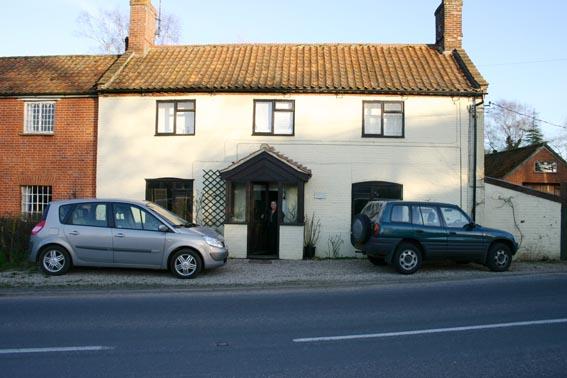
Anybody want to buy a house in Norfolk? From my own humble experience, it would seem the answer is NO. I have been trying to sell this fine-looking former pub complete with a detached studio, in the village of East Bilney, for 12 months now and despite several price cuts and masses of viewings, and no less than four “Sale Agreeds,” it remains unsold. In fact it starts life with a new agent, Belton Duffy, from the start of this coming week.

The most recent sale agreed has fallen through because our buyer has lost his buyer. Again. This particular buyer is now responsible for two of the four failed sales and he may yet make it across the finishing line to become the proud owner of Swanhaven. But he is moving from a smaller house which is (or should be) attractive to first-time buyers and, as everybody keeps telling us, first-time buyers are thin on the ground at the moment.

Ten days ago, our now ex-agent rang to say he was “very confident” that our buyer had landed a good first-time buyer and that our deal was back on again. He added that he just had to run through some credit checks on the first-time buyer, what he referred to as a “qualification procedure.” He was awaiting an accountant’s report and the accountant was away on holiday. So far, so Norfolk. This week, the accountant’s report turns up, the young man comes in for his qualification meeting, he passes with flying colours, the deal is on, the chain is live. Closing the deal is the very stuff that estate agents live for and I can’t help but get caught up with his enthusiasm, especially as this deal has taken so long and proved to be so problematic.

Time to pop open the champagne? Not quite. The next morning, the young man has “reconsidered.” He is just off on two weeks holiday and he wants to “think about it.” Yeah, whatever.

Exasperated? You bet. Angry? Not really. Stoical is the word for how I feel about it all now.

This morning as I lay in bed I started thinking about this young man, our abortive first-time buyer, and I put myself in his shoes. As a first-time buyer, he would be having to borrow maybe 95% of the £115k asking price. Whilst he would probably be delighted to know that he qualified and that his credit ratings all stacked up, I can quite understand anyone who might just feel a little reticent about getting into so much debt. Taking on a mortgage for a first-time is a defining point in many people’s lives, not quite up there with becoming a parent or getting married, but not far short either. Now in a booming house market, the attractions of a 95% mortgage are obvious: because of the gearing effect, your equity increases no less than twenty times faster than the house price. You only need house prices to increase by 5% per annum, and your equity doubles in Year One. But in a stagnant house market, there is little, if any, advantage in taking out a large mortgage, as opposed to renting. And, of course, in a falling market, which Norfolk has been for the past 12 months, anyone with a large mortgage is losing twice over. So yes, I can understand this guy’s reticence to become a player in the Norfolk housing market.

No doubt our little drama is being replicated tens of thousands of times across the country. It’s hard not to extrapolate, to read this young man’s behaviour as a proxy for the whole housing market, at least as far as first-time buyers are concerned. The agents will be trying to figure out where the price point is which switches his behaviour from sniffing around to actually closing the deal. But from his point of view, a mortgage is a mortgage and whether it’s £105k or £95k or even £60k, it’s still a huge amount of money and it’s really only an attractive option for him if taking on this mortgage brings wealth along with it, and the only mechanism that delivers that is rising house prices. Viewed from this perspective, it’s easy to grasp just why the housing market tends to overshoot on the way up and on the way down as well. It’s why the economists fabled “soft landings” so very rarely happen. It doesn’t bode well for the next couple of years, does it?

So go and enjoy your holiday, unknown first-time non-buyer. I have a sneaking admiration for you and I suspect you may well have made the right decision.

Meanwhile, anybody want to buy a house in Norfolk?

19 Aug 2005

What’s Belgium got to teach us about housebuilding?

To British students of modern manufacturing methods, Danilith are known (if they are known at all) as the Belgian housebuilders with the robot bricklayers. But that is only a small part of the story. For Danilith is a vertically integrated housebuilder of the type that just doesn’t exist in the UK. They are a family business that has been running since the 1920s and they own a large plant in Wortegem, which they use to build as much of their houses as they possibly can. Not only do they prefabricate wall, floor and roof panels, but they make their own joinery as well. They employ 260 people, use very few subcontractors and they undertake around 250 projects a year, mostly individual homes in Belgium and Holland, mostly fully finished.

Let’s just consider this last sentence. 250 houses built each year by 260 people. That, in itself, is remarkable. No one at Danilith works more than an 1800hour year if they can help it — Belgian overtime is very heavily taxed so there is an incentive to stick to the contracted hours. Of these 260 employees, just 30 work in the factory, another 100 on site erecting and finishing the houses and the remainder in various admin roles. So essentially, 130 workers are building over 200 houses each year. That’s just under 1200 hours labour going into each house. In comparison, the standard British site-built home takes 3000 hours to construct. Danilith workers are thus over twice as productive as their UK equivalents.

This is reflected in the prices charged for Danilith’s homes. Their brochure shows that the selling price is almost always under €1,000 per sq m (£690/m2). But in Belgium, new homes attract VAT at 21%, which is included in this figure. It also includes 4% taken for design fees and a mandatory 1% fee payable to a private security firm to oversee the construction sites. The net sales price is in fact just €800 per sq m (£550/m2). It’s difficult to see something of equivalent quality in the UK costing less than £900 per sq m. In fact most MMC advocates say that you can’t build at less than £1,000 per sq m unless you are constructing identikit houses in long production runs. But Danilith’s homes are all different, although the elements used to put them together are modular.

In so doing, Danilith produce a very high quality house. We are used to seeing timber and steel framed houses built in factories but Danilith work mostly with brick and concrete, reflecting the prevailing preferences in the Benelux countries and France. The 10metre-long wall panels passing through the Danilith plant are not unique: in Germany, basements are commonly constructed with prefabricated walls. But Danilith have added to this a robotic brick laying machine which first slices the bricks in two lengthwise and then lays them face down on a flat bed, against some retardant paper. Mortar is subsequently brushed into the joints from above before three more layers, concrete, polyisocyanurate insulation board and lightweight concrete are added to the beds, the whole process taking around four days to cure and the final wall thickness being around 250mm. Finally, the walls are hoisted vertically, to be finished by hand on the last of the production lines. Windows, doors, electrical channels and plumbing runs are all set into the walls as they are being constructed. You can view the 15 stage process on the website www.milbank-danilith.co.uk. Floor panels are constructed elsewhere in the plant. Roughly a house a day passes through the plant: on a traditional British building site this would represent the efforts of around 600 hours work. In the Danilith factory, it’s 25 workers on an 8-hour shift: 200 hours. Plus, of course, a lot of investment in machinery and forty years worth of know-how.

The technology used by Danilith is far from hi-tech. It’s the sort of thing that is used on production lines across the globe. Parts of the process are still carried out by hand and compared to the latest robot car builders it all looks a little primitive. And there are many other smallish housebuilding businesses in Germany and Scandinavia using similar finished-panel systems. However, in the UK, the nearest we come to factory production in housing are the numerous timber frame companies who semi-fabricate wall and floor panels, sometimes referred to as open panel building. This requires insulation, services and finishing on site, both internally and externally.

Danilith see themselves as custom homebuilders first and foremost. Although they make windows and staircases, as well as the wall panels, they don’t sell them to third parties; they only supply their own projects. However, they do undertake a little spec. building from time to time but usually to fill gaps in the production schedule that would otherwise have them laying off staff. This is quite revealing in itself. It’s frankly hard to imagine a British firm adopting such an attitude. Indeed, it’s just the sort of action that shows the gulf between Anglo-Saxon and Continental business practice. Whilst we are busy cutting costs and growing market share, the Belgians are putting the interests of their workforce first and foremost. Whilst many British economists would highlight Danilith’s working practices as being a prime example of Eurozone featherbedding, they would also have to admit that it’s resulted in productivity levels which we in the UK can only aspire to some time in the not-so-near future. The Belgians are clearly doing something right.

This remarkable company would like to transfer some of its know-how to Britain. They have found a willing partner in Milbank, who, like Danilith, area a family-run company with a keen interest in masonry prefabrication. Milbank are big in precast flooring in South East England and have slowly grown their business to embrace haulage and joinery. But they are not housebuilders. Both Milbank and Danilith are keen to start building homes in the UK but there are significant obstacles to overcome in order to establish a British version of Danilith.

Perhaps the biggest problem is that there simply is no tradition of custom home building in the UK. On most of the continent, custom home building is the principal route by which detached houses are built. Individuals buy plots — relatively cheaply — and commission a new house to be built on them, without spending a great deal of time working on the project themselves. In Britain, the new homes market is dominated by speculative builders who build solely for sale: there are around 15,000 individual homes built each year but most of these are taken on on a semi-DIY basis with the selfbuilders acting as their own contractors. The burgeoning timber frame sector prefers to offer a water-tight shell option and lets the selfbuilders finish the houses off in their own time. One or two Continental companies offer a full-build service, notably Huf Haus and the Swedish House Company, but they only account for a tiny number of new homes each year, probably under 100 in total.

Typical of Continental custom homebuilders, Danilith is set up to build one-offs. Everything in the Danilith system is modular but provided the design fits the modules, almost any design can be built. They don’t aim to achieve economies of scale by mass production: their goal is to simplify everything down to a set number of options and to avoid prototyping. That way they avoid mistakes and they keep costs to a minimum, without becoming too repetitive.

Quite why the major British housebuilders have failed to take up factory-building Danilith-style is a mystery. Their pattern book approach to housebuilding, combined with the guaranteed volumes, ought to lend itself to prefabrication. But for some reason vertical integration has never appealed to British builders and no one has ever seen fit to try. The only plc housebuilder to currently use a significant input of prefabrication is Westbury, who have built the largest timber frame plant in Europe (Space 4) to supply some of their new homes. But Space 4 is a long way short of what the likes of Danilith and Huf Haus do.

The big question is this. Can the cost savings shown by Danilith be achieved simply by copying the technology or is the different business culture an essential part of the mix? Whilst it ought to be easy to introduce robot bricklayers, it will be much harder to integrate the Continental work ethic needed to keep the robots ticking over.

15 Aug 2005

Cleve Prior Webcam


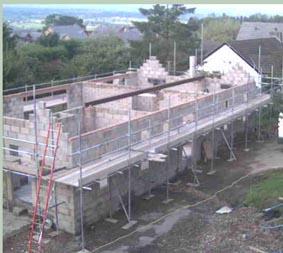
Many selfbuilders have run websites, photographing and recording their builds along the way. But this is the first one I have come across where a webcam has been installed so you can watch the action "live." The house is in Lancs and is being built by Tim and Val Fairless, frequent contributors to the selfbuild list. The webcam isn't quite as gripping as the cricket, but it's tempting to leave it on it the corner of your screen. As the caption says "If the image does not move, then nothing is happening."

www.timval.com/webcam.html

Basement Advice

I need lots of information on building a basement. I'll take anything from construction, design, good build, bad builds, tanking, damp proofing, companys, as I said, anything. My project is to build an art studio with a basement measuring 30 feet long by 20 feet wide, going down 6 feet to subfloor leaving two feet about ground level for windows and vents.

Thanks Mostyn Powell

Mark reckons:

The one thing that people really fear, when considering basements, is that they will leak. And it's not a groundless fear. The insurance claims records on new basements is appalling, enough for insurance bodies like the NHBC and Zurich to often specifically exclude basements from their cover. The problem is that relatively minor errors can result in total failure whereas above ground they would most likely pass unnoticed. And of course leaky basements are difficult and costly to fix.

There are basically two techniques for stopping basements leaking: tanking and drainage. Ideally both should be employed. There are several ways of building basements and they are all potentially excellent yet none of them is completely foolproof. You need an appropriate design to start with and you need to employ contractors with above average competence.

One of the problems with basement design is that no one quite knows who to talk to at the outset. If you go to a "basement specialist" they will most likely be trying to sell you their pet system, regardless of whether it is suitable for your site. An architect? Probably won't have a clue. Neither will most structural engineers. An "experienced groundworker?" You may be lucky, you may not, not many UK groundworkers have ever built a basement. You could do worse than check into the Basement Information Centre www.basement.org.uk and key into their database, although it keeps throwing up Phil Hewitt as the only independent consultant philhewitt@btconnect.com

One other tip,
Selfbuilder Lol Berman is just completing a new house in Cambs with a 17x8m basement. He costed out four options at the outset:
• ThermoneX £77k (ThermoneX make prefab basement walls, craned into position)
• Beco £56k (Beco are an ICF business, using polystyrene moulds into which concrete is poured)
• Ordinary Local Groundworkers £58k
• David Ball's Pudlo System £41k (Pudlo is a waterproofed poured-in-situ concrete system produced by the David Ball Group www.davidballgroup.com)

He went with the Pudlo system and thus far it's been fine.

12 Aug 2005

Sasmox


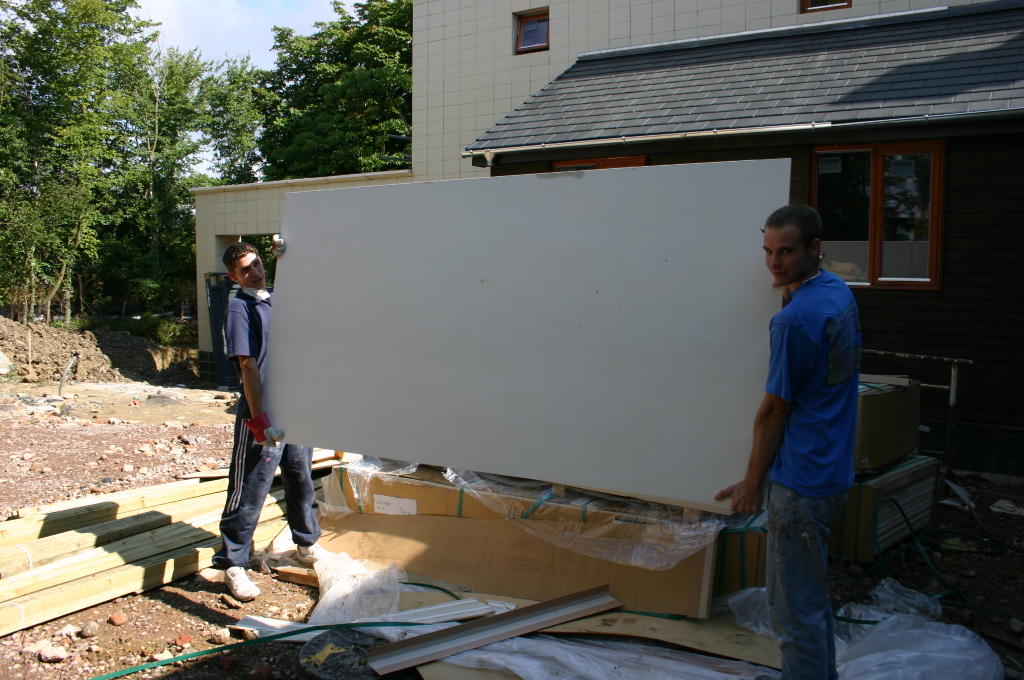
David Birkbeck’s use of the Finnish building board Sasmox as a wall/ceiling board is unusual. The UK selfbuild community are keen users of Fermacell, a similar product, made in Germany, and I was interested to make the comparison between the two boards. Sasmox is slightly more expensive than Fermacell: a plasterboard:Fermacell:Sasmox cost ratio would go 1:3:3.5 or maybe that should be 2:6:7. It’s a very simple product made of spruce cuttings (of which Finland has no shortage), waste gypsum and water: it’s pressed together in stainless steel clamps, there are no glues or additives. Whereas Fermacell doesn’t really like water — it tends to belly — Sasmox is virtually unaffected by it. Where Sasmox really wins out over Fermacell is with the finish: it’s smooth and shiny, doesn’t really require any painting other than filling between boards and over screw holes.

The downside of all these heavy boards (Sasmox weighs 1250kg/m3, about 40% more than plasterboard) is that they are really not easy to work with. You need a jigsaw to cut them rather than just scoring with a Stanley knife, plus you really struggle to get the boards onto ceilings simply because they weigh so much.

Sasmox is distributed by the Panel Agency www.panelagency.co.uk, Tel 01474 872578. The contact is Roger Kingsley who is happy to deal with largish (whole house) orders direct.

Chateau Birkbeck nears Completion


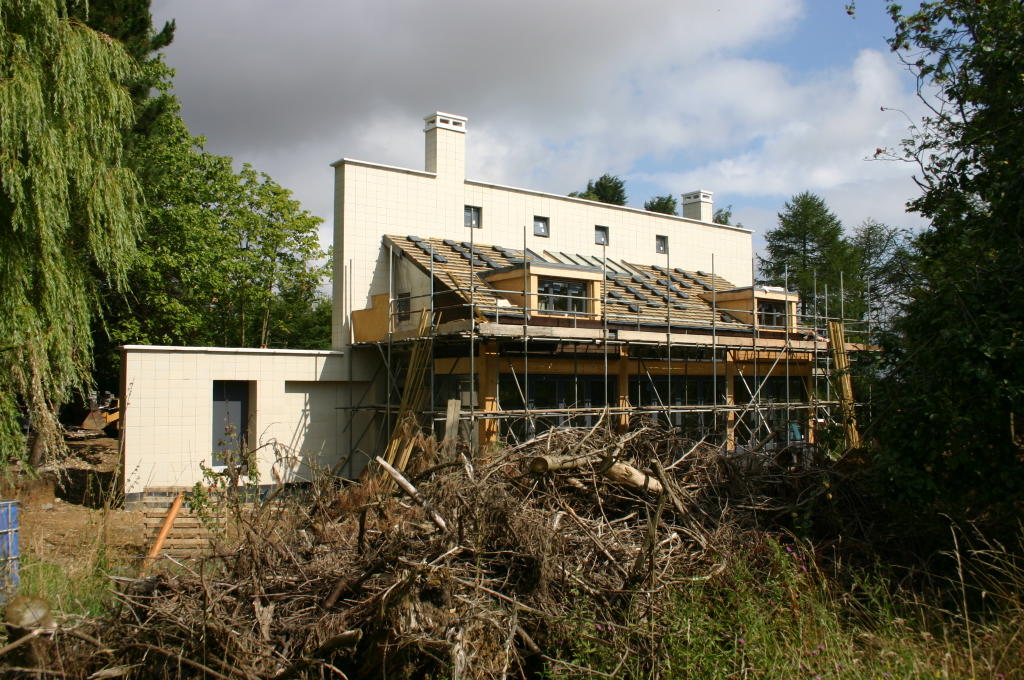
Friday morning, drive down to Thaxted to see how David Birkbeck’s new house is coming along. David was the first editor to hire my keyboard, back in 1996, and now he runs a consultancy called Design For Homes which sets out to get housebuilders to hire architects. He is in the middle of his first selfbuild and I have been following the story ever since he first put an offer in on the plot. The house is, naturally, very designey: the architects are Snell David. I was last here in January when the extraordinary spine wall was taking shape with these unusual blocks, which are glue-mortared.

Now the house has taken shape around it and it’s a magnificent structure. It’s a magnificent site, which helps matters; a sort of woodland glade with a large pond and the house has large glazed panels looking out over the pond. If I was feeling critical – and I’m not today – I could say that it suffers from being an architect-driven project, which is overly complex and unnecessarily fussy. But on this balmy August day, it just looks very cool and comforting and, indeed, just a little inspiring. David isn't on site but he speaks to me over the phone and enthuses about the whole structure being both very modern yet very Essex. I think he's referring to the timber wall panels but even these turn out to be something unusual, in this case Thermawood, a heat treated softwood which should last decades, "unlike all that nasty cedar," he says "which is already beginning to look tatty." David can be very funny; whilst he works as a champion of good house design, this doesn't mean he champions ALL new house design.

Like most selfbuilds, this house seems to be being assembled by all kinds of odd people. I am met and tea-ed by Clare’s brother who is about to become a primary school teacher. Upstairs are two lads who normally work as exhibition display builders: they are putting Sasmox building board in place on the many studwork partitions. This is a non-traditional skill if ever: no one here has ever worked with Sasmox before. It’s heavy and a little fragile but it doesn’t need finishing, unlike plasterboard.

The scaffolding is about to be struck and David says he hopes to be in within “a few weeks.” Having knocked about the selfbuild scene for many years, I should know that this is wildly optimistic but sometimes you can’t help but be dragged along by all the optimism.