Part O landed in our inboxes in December 2021, along with updates on Part F (ventilation) and Part L (energy efficiency). These standards will come into effect in England only in June 2022. Part O is new: it deals with the risk of summer overheating in new homes, a topic previously touched on, or rather skated over, in Part L. The risk is growing as summer heat waves become more commonplace, and as our predilection towards more glass seems to grow ever stronger, it's perhaps time to legislate the problem away, which is what Part O is attempting to do.
But has it succeeded? My first impressions are that the Department for Levelling Up, Housing and Communities has made an absolute pig's ear of the task and will be causing countless headaches for building designers and inspectors for years to come. It's not a lengthy document, coming in at just 16 pages before it starts the Appendices (15 pages). And maybe it's not lengthy enough, because it rests on some heroic assumptions and all-to-brief definitions of how we like to design, build and live in new homes. There is one example, discussed at the end of this blog, which identifies an unbuildable window because it can never pass both the required tests.
But first, the question must be asked as to what exactly Part O is trying to achieve. If it was just an end to the threat of summer overheating, it could have just told us to fit air conditioning into new homes. That's exactly what happens in lots of climate areas where sweltering summers are the norm. Air conditioning is also pretty much the norm in commercial buildings in the UK, which maybe explains why Part O is aimed solely at residential new builds. But air conditioning remains uncommon in homes, mostly because our climate is pretty mild and we are rarely troubled by summer heatwaves for more than a few days, and even these are pretty tame by global standards.
But if they are a concern, why not just make air conditioning mandatory and have done with, just like we do with space heating? The reason lies in the added energy used in air conditioning. The feeling is that if we can do without air conditioning we should, as it will save huge amounts of energy use in summer. All true but no one seems to have take on board that if we are to have enough zero carbon, non-fossil derived energy around to keep us warm in winter, then we will almost certainly have a huge surplus of the stuff in summer. Maybe we don't need to be saving energy in summer. This sort of conjecture is not addressed in Part O.
What Part O does look into is the so-called passive methods of preventing overheating. These are techniques and designs which minimise the threat of overheating and aim to raise the threshold above which mechanical cooling becomes essential. The simplest way of doing this is to have smaller windows, especially ones that face south and west, those which catch most of there sun's summer heat load. But there are many other ways. There are external shutters, awnings, brise soleil, low-g glass which restricts the amount of infra-red passing through glass, good ventilation systems, clever planting (vines, trellises), and more. The world of house design is full of ingenious methods of limiting solar gains. And Part O is aware of them all.
However, if you want to take advantage of these clever design ideas, you will be forced to go down the route of undertaking a dynamic thermal modelling exercise, along the lines set out in CIBSE's TM59 model. This is a much lauded document that was published in 2017 and is something rather similar to the SAP assessments undertaken by specialists in order to work out the heat load of a new home.
So far so good, if annoyingly expensive. These overheating studies will not come cheap. If you want lots of glass in your new home, then expect to have to go down this route.
But Part O presents us with an alternative route to compliance, using a simplified method that concentrates on just two aspects of this overheating problem, namely reducing glazing areas and increasing window opening sizes. Stop and digest this for a moment.
These two aims are contradictory. The first set of guidance tables, on page 6 of the document, are concerned with making windows smaller, in order to reduce unwanted solar gains, whilst the second set, on page 7, want windows, albeit opening ones, to be larger, to facilitate through ventilation. Do you foresee problems here? You'd be right.
The principle concern of the first tables, 1.1 and 1.2 is to reduce solar gain by putting a lid on how much glazing a house or flat should be allowed to have. This is dependent on a number of factors.
1. Whether the structure has cross-ventilation or not. Table 1.1 deals with situations where there is cross-ventilation; Table 1.2 deals with those without. Cross-ventilation is defined as the ability to ventilate using openings on opposite facades of a dwelling. It adds that having openings on facades that are not opposite is not considered cross-ventilation, e.g. in a corner flat. That's it. It sort of makes sense but it also leaves many questions unanswered. What about using an opening rooflight for ventilation? Or having opposite openings on different floors? Or in opposite facades but separated by doors? You can see that the reality is rather more complex than this flimsy definition suggests, and that common sense doesn't seem to play a part here.
2. Whether the dwelling is in a high-risk location or a moderate one: there don't appear to be any low-risk ones. High risk is defined in Appendix C and includes most of inner London and central Manchester, defined by postcodes. Everywhere else is deemed to be moderate-risk. Quite why central Manchester is deemed to be high risk but central Birmingham moderate-risk is not explained, but let's not get bogged down here.
3. The next thing to decide is which way does the "largest glazed facade" face. The choices are North, East, South or West. What exactly is the largest glazed facade? Indeed, what exactly is the definition of a facade? Does it include roofs? What about buildings that are T-shaped or stepped? Where does a facade begin and end? None of this is explained. And what about if your large glazed facade is facing North-East? Do you average the difference? No guidance is given on this.
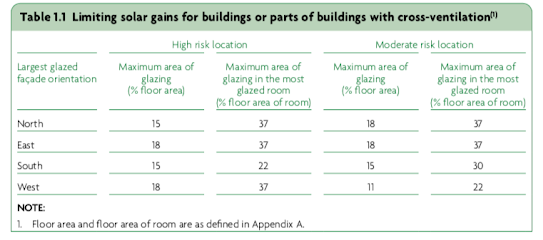
So having established all this, or not, you then get to look up the numbers in the tables which indicate how large you glazed areas can be. They numbers are ratios, all related to the internal floor area. The first column shows the proportion of glazing you can have in the house or flat as a whole, relative to the internal floor area of the house or flat. So if you have a flat of 80m2 and your largest glazed facade is said to face north, then you can have 15% of 80m2 (which is 12m2) of glazing throughout the flat. How or where this glazing is distributed on the various facades is not addressed, although by definition the largest amount must be on the North side. Move to the next row, East, and you find that you will be allowed to have 18% of your wall areas glazed. 15% if it's North, 18% if it's East.
Now just why you should be allowed more glazing if your largest glazed facade faces East isn't explained, nor does it seem logical as North facing glazing will receive little of no solar gain because the sun never shines directly through it. You would expect the South facing facade to be the most vulnerable to summer heat gain, but its ratio is set at the same as the north. If you are being polite, you would say this is counter-intuitive. The alternative explanation is that someone has made a mistake.

The more you stare at these figures, the more questions pop up. It may be coincidental but there are only four values listed here on Table 1.2 (26, 18, 15 and 11) spread across 16 cells in the table. Something feels fishy....
There is also no guidance on roof lights or skylights, let alone glazed ceiling panels, increasingly seen in modern home design. Are these part of any facade and, if so, which one? And is their use to be included in the overall floor area: glazing ratio? Nothing you might do to minimise the risk of solar gain, such as brise soleil or shutters is taken into account. Neither is the quality of the glazing. It's also down to size and distribution of the glazed areas.
We then move onto the Maximum Area of Glazing in the Most Glazed Room. You can see what they are driving at here, but once again the guidance makes very little sense. Again they are using a floor area: glazed area ratio. The floor area of the most glazed room might seem easy to work out but here is a rider they have added in Appendix A. To quote, "where the room serves more than one activity e.g open plan kitchen and living room, the area with the largest glazing area should be assessed and the room calculated based on a room depth no greater than 4.5m from the glazed facade." At a stroke they have reduced, probably halved, the size of the room, thus altering the key ratio calculation.
The maximum allowable glazed area vary from 37% of the floor area down to 22%. That means for a room floor area of 20m2, you could have 7m2 of glazed area in the most lenient orientations, down to 4m2 in the most taxing. That's actually quite a lot of glazing. But what is intriguing and wholly unexpected is that, if you have a Westerly glazed facade, you can have far more glazing in the high-risk locations than you can in the moderate-risk. And in the moderate-risk location, they are happier for you to have more glazing in the South facing facade than you can have if you face West. Really?
The second pair of tables in Part O, 1.3 and 1.4 (pictured), deal with expelling excess heat from the building by way of opening windows, sometimes called purging. 1.3 deals with houses or flats with cross ventilation, 1.4 deals with those without.
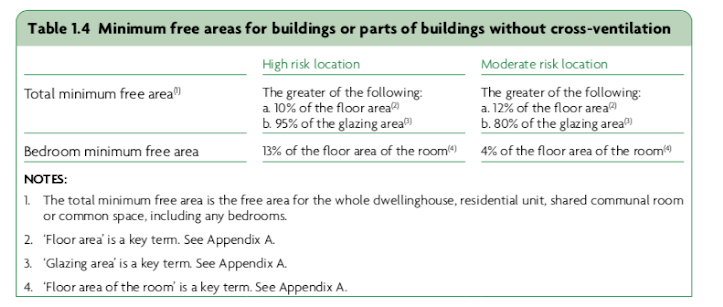
Now purge ventilation has long featured in another building regulation, Part F, which as has been noted was also updated an published in December 2021. But Part F's purging is a rather different animal to Part O's. Part F is all about getting rid of nasty smells, smoke and pollution, whereas Part O seeks to dissipate excess heat. Part F requires that ever habitable room has a window somewhere that can be opened (even if its in an adjoining space) or at least ventilated like a bathroom or loo. It is really only interested in intermittent purging. Part O on the other hand is aimed at overnight heat purging, the sort of thing that is common in warmer climates where shutters are used to let the cool night air blow through the houses and flats. Rather like the two tables which deal with excess solar gain, Tables 1.3 and 1.4 concern themselves with setting minimum limits on window openings. Once again we have to look up definitions to work out what the hell its all about. One critical terms is the Total minimum free area. This is all to do with the size of the window and how far it opens. In fact there are a series of supplementary tables in Appendix D which show the calculations of free areas in window openings at various degrees of opening.
It transpires that what they want here are minimum openings, expressed as either a ratio to the floor area or the overall glazing area. They could make things far easier and say that a room of 5m2 needs an opening of 0.3m2, and a room of 10m2 needs 0.6m2. That would be much easier to comprehend. But instead they offer options. The minimum free area (i.e. opening) should be (in moderate locations with cross ventilation) 9% of the floor area or 55% of the glazing area, whichever is the greater. It seems to refer to the whole house openings:floor area ratio, but following on from the main calculation there is a supplementary ratio which applies to bedrooms. Bedrooms are the place where night-time heat purging is the most critical. Here it asks for 13% opening area:room size in high risk locations and just 4% opening area: room size in moderate areas. As moderate risk locations are required to have 9% openings:floor area, it seems likely that the whole house calculation will override the individual bedroom one.
The question of cross-ventilation is also here, and it is why there are two tables. A house or flat without cross ventilation gets a much higher standard to meet with up to 80% of the glazing area being classed as openable. That will be nearly every window and each will have to be openable to 90°.
This of course causes other issues, which also get detailed in Part O. Open windows are all very well, but some people live in noisy neighbourhoods, or have fumes they want to keep out. There are security issues and safety issues, especially where there are small children. There are also summer rainstorms to consider, not to mention insects flying in - who wants to be woken by a mosquito? You can see that whilst in theory wide open windows may be enough to dispel unwanted overnight heat, in practice the windows may not get used this way.
The underlying logic of these tables is that the first set of tables want you to reduce the amount of glazing you use to limit solar gains, whilst the second pair of tables want you to increase window size so that open windows can be used to purge unwanted heat. And this is where the problems with Part O's simplified method get tasty.
I have discovered one great example. Take a West-facing room of 10m2 floor area in a moderate-risk area without cross-ventilation. Table 1.2 governs its window glazing size: it states that the glazed area in this room should be no more than 11% of the floor area. So that's (10m2 x 11%) 1.1m2.
Then move onto Table 1.4 which governs the window opening sizes required for purging the heat away. The guidance is that the open area should be either 12% of the floor area (1.2m2) or 80% of the glazing area (0.96m2), whichever figure is the greater. That's 1.2m2 then.
So using this guidance the maximum size of your glazing to satisfy the first test is 1.1m2, whilst the minimum size to satisfy the second test is 1.2m2 of open glazing. Just how you can get 1.2m2 of glazed openings in a window that has only 1.1m2 of glazing isn't explained.
In short, it's nonsense. Any chance of sending this guidance back for a rethink before it becomes mandatory in June 2022?


