31 Oct 2005

Caspar: a Halloween nightmare

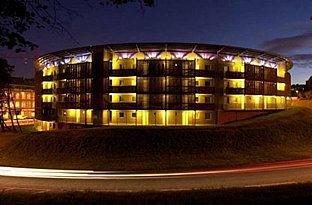
A flagship off-site construction project in Leeds is being evacuated because of fears it will blow down in high winds. Caspar (pictured here) was built in Leeds six years ago by the Joseph Rowntree Foundation (JRF): it was one of the first of the new wave of prefabricated housing projects which the government has been so keen to promote. Oh dear. Oh very, very, dear.

Where did it all go wrong, John?

One of the key selling points for using off-site construction methods is that the amount of snagging is minimised. The aim is to hand over the new building “defect-free.” No doubt when Japanese contractors Kajima handed over the 45 flats that make up Caspar to the JRF for them to rent out as affordable homes for swinging Leeds singletons, much was made of the advantages of all this.

But, according to a report in this week’s Building, something’s obviously been amiss there for a long time because Arup, our premier building consultants, were hired to look into things, and Arup have said “Yipes – get out of there before the next storm.” What they’ve actually said is that there is a 2% chance that the whole building will collapse in high winds. JRF have even admitted that, if the cost of repairing the fault is excessive, they will consider demolishing the whole structure.

Is this the beginning of the end for modern methods of construction, just as the collapse of Ronan Point in 1968 marked the death-knell of system-build in the UK 40 years ago? It’s impossible to say. Caspar (stands for City-centre Apartments for Single People at Affordable Rents (neat or what!)) is just one of many such projects and, unlike Ronan Point, no one has been killed or even hurt. But the failure of Caspar does pose some very uncomfortable questions. Such as…

Why are so many of these schemes prototypes?

Why the curved roof? Doesn’t it look suspiciously like a wing!

Why the curved anything? I thought this was meant to be affordable housing.

Is this stuff really so very different to the 60s tower blocks?

Is it a design failure or is it, yet again, a workmanship issue?

This project was actually conceived as half-modular, half-flat pack. It was designed by Levitt Bernstein, an architects’ practice at the forefront of the new social housing, and factory-built by Volumetric in Bedfordshire. The superstructure was erected in less than three weeks. Each flat is 51m2 and cost £68.6k to build. That’s a typical outcome for these schemes. In other words, they are rather more expensive than conventional builds. They would become cheaper if we built thousands of them but we don’t. Every scheme is different. Every architect has a different spin to put on the concept of off-site construction.

And now here, in the brave new world of modular construction, we have an award-winning scheme about to be condemned.

26 Oct 2005

Why timber frame isn't always quicker

One of the biggest questions every would-be selfbuilder has to address is whether to go brick and block or timber frame. For me, it’s something of a hoary old chestnut, having built using both methods and having been writing articles around this issue for many years. You’d think I’d have pretty set views by now but I don’t. Partly this reflects my tendency towards hopeless prevarication in all things, but it’s also undoubtedly because it’s a question with no easy answers.

However, a site visit this week to a timber frame house in Cambridgeshire gave me pause to think afresh about the issue. This was a site in a conservation area and that meant that there were some quite prescriptive design guidelines: basically it had to match up to the house next door, which was a detached vaguely-Georgian style brick house under a slate roof.

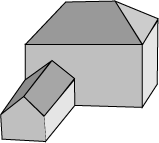
However the new house design was L-shaped, a stepped L-shape no less. What I mean by that is that it consisted of a main rectangular-shaped box (or aisle) of two storeys, with a single storey rear extension. See my attempts at 3D house design (hopefully adjacent) to get a clearer picture. A common enough house layout, you’d think. And you’d be right.

The junction of the two parts of the house is what I wish to draw your attention to. It’s referred to as an abutment. However you do it, it causes problems because there are waterproofing details to be made between the wall of the main aisle and the roof of the extension. Lead flashings have to be fitted over the junction and the wall cavity has to have an effective barrier laid across it in order to drain any cavity water out onto the extension roof. If not, you risk the cavity draining directly down into the house below the junction. Messy.

The subject of cavity barriers can wait for another article. What I am driving at here is the disruptive effect this all has on the construction of a brick-clad timber framed house. On a simple rectangular-shaped house, or even a more complex one, as long as it has a single eaves level all the way around, the brick cladding is taken off the critical path and can be completed at leisure after the framers have departed. Indeed it can go on simultaneously with the roof covering and the fit out inside.

However, split the roof levels like this and the brick wall of the main aisle has to be completed before the extension roof can be covered over. Indeed, on the site I was on, space had to be left for the brickies to have access to the wall, which was being built-up off a steel beam over the opening. Not even the extension roof carpentry could be completed.

Result? Weeks had been lost waiting on the brickies. The roofers had been in and finished the main aisle but had to return for another visit to cover the extension. The scaffolding was gently racking up hire charges. The house could not be effectively waterproofed, let alone secured. All the supposed speed of construction advantages, which timber frame sells itself on, had been lost. In fact it would probably have been quicker to use brick and block on this house.

Had it been such, you would not have noticed that there was a problem here because the roof carpentry wouldn’t have started on either roof until the brickies had got to eaves level all around. And had the external skin been anything other than brick (or stone), the wall above the extension roof could have been finished off at leisure off some form of adapted scaffolding. Boarding, render on mesh, hung tiles, all fine: they are hung off the timber frame and wouldn’t disrupt the critical path. But bricks? They have to sit on something, be it a steel or a foundation: they can’t be ‘hung’ off the background timber frame and they can’t be built-up off the roof cover. So bricks have to be in place before the extension roof cover can be laid.

There’s a lesson in here somewhere. To simplify it right down to basics, despite what the salespeople say, bricks really do work best with blocks behind them. And timber frame is really seen at its best when it’s clad in something other than brick or stone.

Ground source heat pumps

The ten-year payback is here

One of the things 2005 will be remembered for is oil prices. We’ve seen the biggest hike in prices since the 1970s and the signs are that it’s not about to come back down anytime soon, if ever. Oil is the key in determining all energy prices and if the oil price heads north, then sure enough, gas and electricity will follow along in due course. But how soon, and by how much?

It’s a subject I turned my attention to last week as I sought to update my now hopelessly inadequate table on comparative heating costs, on p208 of the 6th edition. This is a key table in my book, the one that is designed to be used to make that all-important decision about how a new house should be heated. The one currently in print is based on an oil cost of 19.5p/lt (equivalent to 1.9p/kWh), a mains gas cost of 1.5p/kWh and an electricity cost of 6.5p/kWh. Yet my last tank of oil cost 34p/lt, a 75% increase.

LPG, which tracks the oil price quite closely, is up by a similar percentage, so it remains about 30% more expensive than oil. But price rises in gas and electricity are much more muted. Making direct comparisons is not easy because of the opening up of the market to dozens of suppliers, each with their own tariffs and payment terms, but the basic drift is that gas is up to around 1.8p/kWh, a 20% rise, whilst electricity still seems to be widely available for under 7p/kWh. Energy analysts seem to think that significant price rises are about to come through in these markets but they haven’t happened yet.

So what effect will this have on comparative heating costs? Mains gas will continue to be a no-brainer for home heating, if you have access to it. But a large proportion of selfbuilds don’t and here the equations are changing. In my last edition, published late 2004, oil only narrowly beat electric ground source heat pumps (GSHP) over a 20-year timespan.

The equation isn’t difficult. The GSHP costs around twice as much to install as an oil boiler plus tank but is cheaper to run because it creates around three to four units of heat for every unit of electricity burned. With oil prices at 2004 levels, it took around 20 years to recover your investment in GSHP: but with current oil prices, this payback time has fallen to less than ten years. In addition to this, the installation prices of oil boilers and tanks is set to get more expensive (though admittedly more efficient) as new legislation takes effect, whilst the market for GSHP is expanding so rapidly that prices seem to be becoming keener. Plus GSHP is still eligible for the Clear Skies grant, worth £1200.

GSHP comes with a couple of other plus points. You don’t have an unsightly oil tank in your garden and the equipment is silent and has no flue. On the minus side, it works most efficiently at heating water to relatively low temperatures, such as you would use with underfloor heating (usually 55°C). It does therefore require a good-sized hot water tank to have a decent buffer of hot water on site. And it requires garden space of at least three times the heated footprint: thus if you are hoping to heat a 150m2 house, you will need 450m2 of garden in which to run the pipe.

Currently domestic heating oil is around half the price of electricity in the UK market. If this ratio holds, then GSHP will be the heating system of choice for all new off-mains gas homes Oil heating systems will only regain their competitive advantage if the price differential returns to its historical 1:3 (oil:electricity). For that we would need to see electricity prices rising to around 10p/kWh, or oil prices falling back to 2004 levels.

23 Oct 2005

I have just become a pre-architect

For my sins, I golf. Not terribly well. I play off a very moderate handicap of 16. Actually for someone who plays most weeks and has done for ten years or more, it’s a crap handicap. I don’t generate enough club-head speed to hit the ball very far. My good drives are maybe only 220 yards long, my average drive probably not even 200 yards. The very many better players I regularly compete with will out-drive me by 40 or 50 yards on most holes. It’s OK. I can live with it. It’s why there is a handicap system that allows total moderates like me to compete with champing young tyros. And compete I do, in the many and various competitions that my club runs.

One of the most interesting aspects of all this competition is that I get to meet new people. It’s a large club, with 1200 members, and though I have grown to know many of them over the years, the competitions regularly seem to pitch me in with perfect strangers. When playing with a stranger, the conversation usually turns to “What do you do for a living?” It’s one of the standard etiquette questions you use when playing golf, along with “Where do you live?”, “Have you got kids?” and “How long have you been a member here?” All very tame, cocktail-party sort of stuff. But for me the “What do you do for a living?” question causes me all sorts of angst because, to be truthful, I am not altogether sure what the answer is.

My regular golfing partner, Steve, if he is to to hand during a doubles match, usually interjects at this point with “What Mark does is work, but not as you’d know it,” which always makes us smile but leaves our opponents none the wiser. But when I am playing singles with a fresh face, as I was this past Saturday, it tends to launch me off into a potted CV of my life since leaving university in 1974. Which isn’t quite the simple answer I would like to give. It would be so much easier to say “I’m an accountant” or “I’m a taxi-driver.”

As it is, I make most of my regular income from writing about house building, but I don’t think of myself as being a writer. I am not really a consultant either. On Saturday, I tried “selfbuild guru” for the first and last time. It sounded pretty silly as I said it and it took me at least three more holes to explain what I meant, having to go through the “what I have been doing since 1974” routine once more.

Anyway, in the bar afterwards, as I nursed a beer to soothe yet another defeat at the hands of a longer hitter, my opponent had another go at tackling my employment status. He asked me if I had any relevant qualifications for what I did. “Of course not,” I replied, almost as a mark of honour, “other than six months learning to be a carpenter in 1982.” I am not an architect, not a surveyor, and what I do is in any event quite different to what any of them do. But I do do a certain amount of consultancy work, advising people about the routes that lie ahead and the options that face them. Glibly, I told him that I was in the business of reconciling aspirations and budgets. He liked that explanation. He was a management consultant himself and he could relate to this. He suggested that what I did was pre-architecture. Yes, that’s it exactly, I said. I am most useful to people if I can have a little time with them before they hire anyone. I am a pre-architect.

I liked the sound of this. Next time I golf with a stranger and the dreaded “What’s your line?” question comes up, I will try this one on them. I don’t expect it will do any better than any of the others but it’s worth a try.

21 Oct 2005

Importing Homes from N America

I'm looking at importing a house from America. Has anyone out there done this? Do you have any company sites or contacts that export to the UK?

You will find that many custom build companies in both continental Europe and N America are more than willing to build a house in the UK or Ireland.

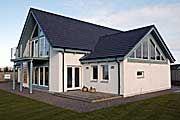
Having said that, the ones that build the most are the ones that have local contacts on the ground over here. The Americans have proven rather poor at this - they build when they are asked but they don't put any effort into export or marketing. The Canadians are much more proactive - they took a large chunk of floorspace at Interbuild in 2004 for instance - and many of their custom builders are excellent. I have seen the results of two; Allouette who are building in West Malling in Kent for Sunley Homes, and Interhabs from Nova Scotia who have been building in Co Mayo and around Inverness (pictured here). Interhabs, I know for sure, are looking for individual custom builds. Find out more from www.super-e.com. Plus the exchange rate on the Canadian dollar is such that they are almost certainly going to offer better value than their neighbours to the south.

Alternatively, there are a number of UK builders who make a thing of building in the N American styles. Tim Crump of TJ Crump Oakwrights is an enthusiastic student of N American (and German) housebuilding methods and has recently completed a few N American style homes.

18 Oct 2005

My wife wants an Aga — can you help?

Edward asks:

My wife and I have recently bought a one-acre plot near Cambridge and have just started getting quotes for the timber frame. I'm also shopping around for everything else. One of the things on the list is an Aga.

My wife would `loooooove' to have an Aga, but this would mean I will have to build another chimney, and my concern is that as we are building a small 3-bed cottage an Aga will be too hot. Our house will be extremely well insulated and have under floor heating. I wonder if having an Aga will mean we have to leave the windows and doors open!!

What are your views about Agas?

Mark replies:

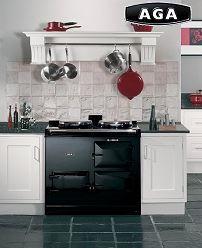
The Aga stands head and shoulders above all other gender issues in selfbuild land. 95% of women aspire to owning one, 95% of men just don't get it. I have seen many an otherwise well-thought out ecologically-slim footprint completely blown out of the water by a shiny new £5,000 Aga in the kitchen. Indeed I suspect that there are many husbands who have only managed to persuade wives to go through the four years of chaos and upheaval it takes to selfbuild by using the promise of an Aga in the kitchen at the end of it all. It's a powerful, if expensive, seduction tool, the ultimate selfbuild babe magnet. If it's the price it takes to get a selfbuild off the ground, maybe it's a price worth paying.

As a man, I am one of those who just don't get it. I have cooked in houses with Agas and about the best thing you can say for them is that they are quaint. But as a man, "What do I know?" as the current saying goes. Yes, the Aga will definitely be too hot for a three-bed cottage, but what’s logic got to do with it.

However I have to hand a possible cure, sent to the selfbuild list by Roger Browne, in Feb 2001. Show it to your wife: she won’t thank you for it, but it's the only known treatment for Agaphilia and it just might make a difference. However, be warned, there are sometimes some unexpected side effects for which the best treatment is Mercury - the range cooker, that is.

STARTS
One of the prime pieces of self-build techno-lust seems to be an Aga cooker. I bought a house that happened to have one, and my advice is:
• don't bother.

Let's recall the history. Back in the days when a coal stove took hours to light and get going, the Aga would have been a godsend. A slow steady burn, 24 hours per day, produced heat which was stored in the body of the oven for use at cooking time. You "only" had to fill it with coal everyday, and turn the riddling handle twice daily.

If you are stuck with coal, I can see the value of an Aga. But if you are cooking with gas, what's the point?

I've had to live with the damn thing for a year now, and have formed the opinion that an Aga is useless apart from its value as a status symbol. It does impress the visitors - but that's not something I care about.

Consider this:

• An new Aga costs around £5,000, including installation. Even an old used one is, say, £1,500. On the other hand, for under a thousand pounds you can get some really nice gas ranges.

• The Aga needs a flue; most gas ranges don't.

• The Aga burns gas night and day, whether you need it to or not. In winter the "wasted" warmth is useful to heat the house; in summer it's like taking a match and burning a pound note every day (if you live in Scotland that is; in England you have to try to burn pound coins).

• In summer you can either open your kitchen windows wide, or turn off the Aga. Then you need a second stove for summer cooking (and many Aga owners do install a second stove for summer).

• If you go away for a holiday, and switch off your Aga, you can't cook with it for a day or so after you get back and switch it on, and it warms up.

• The Aga is supposed to be serviced every six months. Aga servicing costs a fortune. And you have to have the Aga cold for the service engineer. So that's another day or two without cooking every six months.

• If you buy an Aga more than a few years old, it probably has asbestos rope insulation in the lids (newer models have ceramic insulation).

• When you lift the lid, children can't see any indication that the plate is hot, and horrendous burns can result.

• For effective cooking, you need very thick solid cookware with flat machined bottoms. This is the very same criticism that gas snobs make of electric stovetops, yet the Aga has the same problem.

• The flat-bottomed cookware that comes with many used Agas is machined aluminium. Aluminium cookware is one of the suspected triggers for Alzheimer's disease.

• The cook plates have no temperature control. You have to work with what you've got. Sure, you can follow the instructions in the user manual and shuffle your pot half-on-half-off the cook plate. What a fiddle!

• The cook plates are large. Whilst you can juggle two pans on one cook plate, it’s hard to do this satisfactorily. Whether you have one or two pans on it, large amounts of heat are still wasted from the uncovered parts of the surface.

• The cook plate temperature drops during a heavy cooking session. When my wife boils up a batch or marmalade, we always end up finishing it off in the microwave because by then the Aga has lost too much heat.

• Sure, you can do other things with the Aga apart from cook. The Aga instruction manual suggests such bizarre rituals such as ironing clothes with it! It can be useful for drying clothes on top - but of course that's only if you don't want to actually use the thing for cooking at the same time.

• The ovens have no temperature control. OK, there are ways to adapt for that. "You just have to get to know your Aga" say some. Yes, there are workarounds for its quirks. The Aga cookbook is full of Aga versions of recipes. They can take a very simple conventional recipe ("Cook for two hours at 200 degrees C") and turn it into a major epic ("Put on the boiling plate for ten minutes. Cover and move to the simmering plate for 30 minutes. Transfer to a shallow pan and leave it in the simmering oven overnight. Finish off with 45 minutes in the baking oven before serving.") Gimme a break!

• The oven has no timer. You can't just set it to cook your supper in time for your arrival home. Even a £179 B&Q cheapie oven can do that kind of thing!

• There's no window on the oven door. You can't see how your cooking is browning, unless you keep opening the door to check.

• The airflow from the oven is up the flue - there are no baking smells in the kitchen to guide you to when something is "just right". Best way to cope is to go and do some gardening downwind of your chimney. You then have some chance of noticing when it is about to burn.

• Nothing is simple. You can't just "bake a cake" if you have the two-oven Aga. You either have to buy a special cake-baking accessory (I think it's an insulated container), or else you can follow some bizarre instructions to boil away three pans of water on the boiling plate so that you have reduced the temperature of the oven by enough to enable you to bake a cake. Really!

• The Aga can also heat your hot water. In summer, and in winter too, if you don't do too much cooking or use too much hot water or chant the wrong mantras (or expect to get the same efficiency as a boiler).

• Even the smaller Aga takes up much more space than a gas range. You really do have to allow for a bigger kitchen - which adds to your housebuilding costs.

• You also have to lay concrete reinforcement. You can't just put an Aga on a kitchen floor and expect to have any kitchen remaining afterwards.

Yeah, I really love my Aga!

OK, I know all of this is sacrilege to the true believers amongst you.
But when I get around to re-doing the kitchen, one thing is for sure -
the Aga will be sold to the highest bidder.