Dean Barrett asks:
I am considering a self build having nearly completed a general overhaul of our 1960's bungalow. I want to start by reading magazines, and the three I have found on google are:
Homebuilding & Renovating Magazine
SelfBuild & Design Magazine
Build It Magazine
I assume they are all covering the same ground, but wonder which is best?
Peter White reckons:
My favourite (and I think the most popular) is HomeBuilding & Renovating; that said, they repeat the same old stuff every 12 months, so I mainly use it as a source for adverts these days.
Of course, book-wise you must read the Housebuilder's Bible, of all the books that I read on self-building (and there's a lot of them) this was by far the most practical, and therefore useful.
Mark adds:
Thanks for that Pete. Little bit of background on the magazines. Let me first declare an interest. I have been a regular contributor to HomeBuilding & Renovating since 1997 so my comments are perhaps not as impartial as they might be. Nevertheless…
Build It was the original selfbuild mag, started in the late 80s and was for many years the undisputed No 1. It organised a major exhibition each year at Ally Pally and had dozens of little regional shows. HomeBuilding & Renovating was originally called Individual Homes and started shortly after Build It. It took a dozen years, but gradually HomeBuilding & Renovating overhauled Build It in terms of sales, content, photography and advertising. Whilst Build It's exhibitions dried up after 2001, HomeBuilding & Renovating has become undisputed selfbuild exhibition kingpin: it now puts on six exhibitions each year, the next being at Harrogate Nov 4-6, the largest being in March at the NEC. Build It in contrast has rather lost its way since being sold to Mirror Group in the late 90s. In contrast, HomeBuilding & Renovating has pretty much the same crew running it since inception and it shows - many of the staff have selfbuilt and most of the writers know at least something of what they are writing about.
Which leaves Selfbuild & Design, which is a latecomer, having been going since 1998. It's usually a pretty good read, not quite so polished as HomeBuilding & Renovating, but frequently something of interest in each issue, although it has a lot less advertising which, as Pete notes, is often one of the more useful resources in a magazine.
In fact for such a relatively small segment of the market, selfbuild is well served with magazines. Professional housebuilders have just one, the NHBC's house mag Housebuilder; jobbing builders have the freebie Professional Builder, given away at the counter in Jewsons and Travis, architects have a few like the AJ and Building Design, and "serious construction professionals" have Building. You might also look at the magazine from the AECB called Building for a Future, which has some interesting stuff on environmental issues related to construction and often features an eco-home or two.
11 Oct 2005


How to organise groundworks
I have a simple question, I think?
At the groundworks stage of a build, how do people decide where everything is going? I have an overall plot drawing to scale, which was needed for outline planning permission. Is it now up to me to tell the groundworker where to lay the services, drains etc and can he simply just work from my instructions and the overall plot drawing?
What will he need for the foundations - does this come in the form of a building regs drawing? It is all very confusing and seems rather daunting. We also need a pumping station installing as the house is lower than the private foulwater sewer. Who designs this? Can I just tell the groundworker to put it "there" for instance? I think I am getting confused with what the architect requires for submitting to building control and what the groundworker "works" off.
Mark reckons:
A few brave souls decide to build off planning permission drawings, but it's really not to be recommended, esp. if you have never done it before. It would be a bit like setting out to drive from Aberystwyth to Hunstanton with nothing but postcard of Hunstanton pier to guide you. You need a map.
The groundworker will do what you tell him to: he may get it right, he may not. If it's wrong, it will be up to you, not him, to rectify it. What you need is a load more drawings and a few specifications. Normally these form part of a building regs application. In the vernacular of the building trade, "the job needs to be specked up." First the house needs to be detailed so you at least know the dimensions and locations of the walls, and you need to decide which ones will be load bearing. Someone, usually the architect, has to do this work: it's absolutely standard practice. Only then can you proceed to a foundation/floor design, also usually carried out as part of the specking up. The drains and services should also be detailed
with reference to the house layout (where are the bathrooms?) and the site levels. You may find that the drainage suppliers will do this work for you for free, if you supply them with levels and a detailed floor plan.
Then you proceed to the setting out stage where you, in effect, transfer the details from the drawings onto the ground. Then when the groundworker comes to do his stuff, it's all a bit like painting by numbers. He has not so much a map as a paper trail guiding him where to go. It's also much faster, and much less prone to error. Believe me, when the excavators start moving earth around, you really don't want to be guessing where the wall should be or where the pumping station should be going.
>We also need a pumping station installing as the
> house is lower than the private foulwater sewer. Who designs this -
> can I just tell the groundworker to put it "there" for instance?
The position of the pumping station will be partly governed by building regs - Part H covers this in England & Wales - and partly by common sense. There will be a minimum distance you will have to place it from the house (I seem to remember it's 4.5 m min): after that it's up to you and your designer/groundworker. The building inspector will advise.
Don't rush. Remember that every hour spent in preparation saves at least three spent snagging at completion.
7 Oct 2005
On the Federation of Master Builders
 It’s funny how you sometimes stumble across the most interesting things by accident, or they appear when you are least expecting them. Last week at the London HomeBuilding & Renovating show, I was presenting an afternoon seminar entitled Project Management together with David Snell, author of Building Your Own Home. It’s a gig we have shared together for four or five years now and we have a pretty well worked routine advising people what to look out for and what to avoid when choosing and later working with builders.
 Now a couple of weeks before the show, the Federation of Master Builders (FMB), Britain’s largest trade organisation for small builders, had been on to the organisers asking for some representation at this particular seminar. The FMB have sponsored talks at the HomeBuilding & Renovating shows before and they book stand space there to promote their website findabuilder.co.uk. I politely told them that I didn’t think they would add much to our presentation as we worked to a theme and all it would do is interrupt the flow and reduce time for questions at the end — this particular seminar always gets a shedload of questions.
But it came to pass that the FMB sent a delegation to hear what David and I had to say during our seminar. I sort of anticipated the worst. We talk about how there is a large gap between what should happen in theory and what happens in practice and that the vast majority of selfbuild jobs and small extensions take place with no formal written contracts and that if you start insisting on contracts, penalty clauses and withholding money for months after the job is finished, then you can expect to have a much larger quote in the first place. Oh, and don’t do anything silly like pay cash upfront. All good knock about stuff, and slightly different to the advice I would expect to hear from some organisation full of starch-shirted-stiffs.
I fully expected the FMB delegation to have ago at us for being too cavalier with our advice. They all sat there, two rows back from the front, madly jotting down notes. Sure enough, after the Q & A was over, a couple of them sidled over to us and started to ask subsidiary questions. But blow me down if the point they really wanted to get across to us was that they felt it was perfectly in order for a builder to ask for a deposit before the work starts and that we shouldn’t be advising people that this was not a good idea.
Hang on a minute. Give the bloke cash upfront before he’s so much as broken wind! You are having a laugh, aren’t you? No mate, we at the FMB think upfront deposits are a good idea.
Well, bugger me, I never knew that. Turns out that David and I have been the starch-shirted-stiffs all along and that our advice is far too pompous and unrealistic. Or had we just met the urban guerrilla wing of the FMB?
I logged onto the findabuilder.co.uk website to research further. It’s revealing by what it leaves out, rather than what it promotes. It has advice for homeowners on how to spot a cowboy that suggests that he will do the following:
• EVADE giving you references or details of previous jobs
• OFFER you a 'cheap' deal for cash-in-hand.
• SUGGEST you can avoid paying VAT for cash
• CONFUSE you with jargon and complicated explanations
• INSIST that a written contract is not necessary
• SAY they can start tomorrow (a good builder is usually busy)
• CAN'T give you costings because 'things may change'
• LAUGH when you suggest showing them plans
• GIVE you a surprisingly low quote
• CAN only be reached by mobile and don't have an address on their card
• ASSURE you the details are their problem and you don't need to worry
• KNOCK the opposition
All good stuff, but note there is nothing about asking for payment upfront, in my mind one of the true danger signals that you are dealing with a man of straw. The website, their consumer portal, also contains a code of conduct, which they expect their FMB members to stick to when dealing with the general public. Again, nothing is mentioned at all about the vexed issue of upfront payments. The only conclusion you can draw from this is that the FMB implicitly supports the practice of asking for upfront payments from the general public.
The FMB has a different website, www.fmb.co.uk, dedicated to their members who are all small builders. There you can see a different side to the oganisation. “The FMB is a trade association established over 60 years ago to protect the interests of small and medium-sized building firms.” By encouraging the practice of upfront payments, perhaps?
Coincidentally, our dear government is about to give a huge boost to the FMB by making them a lead player in their new scheme to “kick out the cowboy builders.” Their previous scheme, the ill-fated QualityMark, was finally put to bed earlier this year after five hopeless years in which a lot of our money was spent by central government and almost nothing happened on the ground. In its place we are going to have Trustmark, which is very much QualityMark-lite. In fact very-lite. Whilst QualityMark demanded that member firms paid 0.75% of turnover in order to join, Trustmark is free for the first two years and will only then cost about £10 a year to maintain membership, if the contractor is member of an accredited body (i.e. FMB), although maybe £300 a year if not. Trustmark will be an umbrella group, inc. all FMB members, and many other trade associations. It will offer warranties against defective work and protection against members going out of business during the job, but the warranties will have to be paid for as extras by the clients. In other words, there is protection if you choose to pay for it as an additional insurance policy. Which people just won’t do.
Like the FMB’s own findabuilder.co.uk site, the trustmark site also has some guidance about “protecting yourself from rogues”. And, of course, there is nothing about the dangers of paying upfront. Maybe the FMB had that bit surgically removed as its price for coming on board and giving the organisation some weight in the marketplace. But I can’t help feeling that the FMB will gain more from Trustmark — a DTI sponsored initiative — than vice versa. And the poor old consumer won’t be the least bit protected by either body, as far as I can tell.
So is it ever OK to pay upfront?
I reckon there are some circumstances where it’s fine for a builder to request an upfront payment. Notably where the client has specified some fittings which have to be paid for in advance, or at least require a substantial deposit and for which the builder is acting as a middleman. This happens with a lot of imported gear and it also happens with a large number of timber frame companies. There is also a case for demanding a small deposit on small jobs where the client needs to show that they are serious, say on a new kitchen or a bathroom. But for 90% of building jobs, the materials are (or should be) being purchased on credit and the labour is being paid for a week in arrears so there should be no reason for the contractor to demand an upfront payment, except to ease his cashflow. And a builder with a stretched cashflow is, in my book, one to avoid.
On the other hand, there is good reason to pay a builder in stages as the job progresses. It’s best to tie these interim payments in with landmarks so that everybody knows where they stand. A builder with a solid cashflow would be able to work on something like a payment once a month, maybe once a fortnight. Any less than that and the warning bell should be ringing. The very fact that the FMB doesn’t omit “demanding payment upfront” as one of its code of conduct points suggests strongly to me that many FMB members simply haven’t got the wherewithal to float a small building job. That’s not to say they won’t do a good job, but I personally would be far happier to employ a builder who belonged to no trade organisation who didn’t demand cash upfront than one who was a member of the FMB who did.
5 Oct 2005
Selfbuild at a crossroads
Whilst selfbuild is now fated on TV and in the press and has become an aspiration for hundreds of thousands of people, the supply of land needed to keep the ball rolling is in danger of drying up because government policy is set against low density housing.
As recently as 1997, 47% of all new homes were detached. By 2004, it was just 19%. This startling turnaround has been entirely due to changes in planning policies, resulting in hundreds of Poundbury-style high density housing sites springing up across the country. Whilst the demand for these new homes remains reasonably strong, nobody is complaining too loudly.
But in killing off the sterile and little loved “executive housing” estates, the new planning policies also threaten to stop the flow of innovative and experimental homes being built by today’s selfbuilders.
One of the side-effects of the new planning regime is to increase demand for single building plots. This, in turn, makes the whole process of homebuilding more expensive and results in the build budgets being cut. You already have to be fairly well-off to afford to buy building land: soon only the very rich will be able to build interesting houses on these plots.
 Contrast this with the situation in the rest of Europe where land is often set aside specifically for selfbuild schemes, which most people regard as a sensible use of rural resources. Even in the more densely populated areas like Germany and the Benelux countries, you will regularly come across building plots for sale for the same price as a large car. The pair of plots in Belgium pictured here were on offer at €40k each earlier this year. In stark contrast, building plots fetch rather more than the cost of an average house in SE England. The painful truth is that the more we spend on the land, the less we have to spend on the building and as a result most of our designs and our building methods are decades behind what has been happening elsewhere. Whilst we seem to be collectively mesmerised by the gleaming efficiency of German-import Huf Haus, who have now built around 50 houses in Britain, the reality is that is how 30% of all houses are built in Germany.
The nearest we come to factory-made houses is our native timber-frame industry, which supplies just the skeleton of the house. In Scotland, where land is relatively cheap, it’s taken off in a big way and accounts for nearly two thirds of all new homes and an even higher percentage of selfbuilds. Scotland also has an extremely well-developed selfbuild infrastructure with hundreds of businesses competing to design, finance, insure selfbuilds, besides actually building them.
South of the border, the situation is rather more piecemeal. In areas where land is less expensive, selfbuild flourishes as a viable alternative route onto or up the housing ladder for people on ordinary incomes. But as you get nearer to London and land prices escalate, “normal” selfbuild, as practiced in the rest of the world becomes impossible. Virgin plots with road frontage are now very rare and what we are now seeing is that the majority of single plots coming to market have been formed by the subdivision of large gardens.
Whether this on-going densification of our villages and suburbs is something future generations will thanks us for is doubtful. This process is a direct consequence of the pressure, coming from amenity groups such as the Council for Preservation of Rural England, not to release greenfield sites around villages. But the side-effect of this policy is to destroy the siting and integrity of much of our most cherished housing stock by cutting swathes through long-established gardens and erecting fenced off entrances to backland development. Currently, this is only way that the huge pent-up demand for single building plots can be met.
Selfbuild should form part of the very backbone of rural life, enabling communities to grow organically from within rather than by having alien estates grafted onto them by master planners and national developers. But today planning matters are all dealt with by remote local authority offices whose wishes are, in any event, increasingly being overruled by central government. Selfbuild as an aspiration has taken root with the British public: but for that aspiration to become reality for more than a few, government needs to recognise that it has the potential to become a significant contributor to our future housing stock, as it is in most western countries.
As recently as 1997, 47% of all new homes were detached. By 2004, it was just 19%. This startling turnaround has been entirely due to changes in planning policies, resulting in hundreds of Poundbury-style high density housing sites springing up across the country. Whilst the demand for these new homes remains reasonably strong, nobody is complaining too loudly.
But in killing off the sterile and little loved “executive housing” estates, the new planning policies also threaten to stop the flow of innovative and experimental homes being built by today’s selfbuilders.
One of the side-effects of the new planning regime is to increase demand for single building plots. This, in turn, makes the whole process of homebuilding more expensive and results in the build budgets being cut. You already have to be fairly well-off to afford to buy building land: soon only the very rich will be able to build interesting houses on these plots.
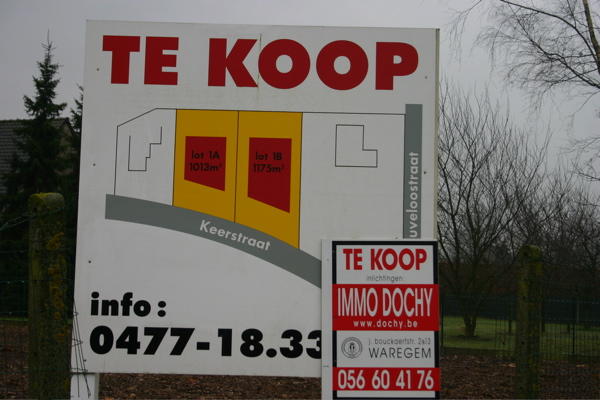 Contrast this with the situation in the rest of Europe where land is often set aside specifically for selfbuild schemes, which most people regard as a sensible use of rural resources. Even in the more densely populated areas like Germany and the Benelux countries, you will regularly come across building plots for sale for the same price as a large car. The pair of plots in Belgium pictured here were on offer at €40k each earlier this year. In stark contrast, building plots fetch rather more than the cost of an average house in SE England. The painful truth is that the more we spend on the land, the less we have to spend on the building and as a result most of our designs and our building methods are decades behind what has been happening elsewhere. Whilst we seem to be collectively mesmerised by the gleaming efficiency of German-import Huf Haus, who have now built around 50 houses in Britain, the reality is that is how 30% of all houses are built in Germany.
 The nearest we come to factory-made houses is our native timber-frame industry, which supplies just the skeleton of the house. In Scotland, where land is relatively cheap, it’s taken off in a big way and accounts for nearly two thirds of all new homes and an even higher percentage of selfbuilds. Scotland also has an extremely well-developed selfbuild infrastructure with hundreds of businesses competing to design, finance, insure selfbuilds, besides actually building them.
South of the border, the situation is rather more piecemeal. In areas where land is less expensive, selfbuild flourishes as a viable alternative route onto or up the housing ladder for people on ordinary incomes. But as you get nearer to London and land prices escalate, “normal” selfbuild, as practiced in the rest of the world becomes impossible. Virgin plots with road frontage are now very rare and what we are now seeing is that the majority of single plots coming to market have been formed by the subdivision of large gardens.
Whether this on-going densification of our villages and suburbs is something future generations will thanks us for is doubtful. This process is a direct consequence of the pressure, coming from amenity groups such as the Council for Preservation of Rural England, not to release greenfield sites around villages. But the side-effect of this policy is to destroy the siting and integrity of much of our most cherished housing stock by cutting swathes through long-established gardens and erecting fenced off entrances to backland development. Currently, this is only way that the huge pent-up demand for single building plots can be met.
Selfbuild should form part of the very backbone of rural life, enabling communities to grow organically from within rather than by having alien estates grafted onto them by master planners and national developers. But today planning matters are all dealt with by remote local authority offices whose wishes are, in any event, increasingly being overruled by central government. Selfbuild as an aspiration has taken root with the British public: but for that aspiration to become reality for more than a few, government needs to recognise that it has the potential to become a significant contributor to our future housing stock, as it is in most western countries.
4 Oct 2005
Spluttering SIPS
 I have been writing about SIPS (Structural Insulated Panel Systems) building panels for five years now. In that time I have been on six sites where they have been being used. Each time there has been a tremendous amount of enthusiasm for what’s being, or has just been, built. And yet each time there also seems to have been a catalogue of mishaps and delays. These are somehow never attributed to the SIPS building system itself, but seem to be caused by the shortcomings of the designs or the supplier.
 This time last year I visited a site of six terraced houses being built by Nick Robinson in Hampshire. Nick is a professional housebuilder with a keen interest in new construction systems. I had previously seen a site he had built out using steel frame, which had worked pretty well. But when he enquired about using steel frame again, Corus, the manufacturer, told him they were no longer interested in supplying small sites so he had to look elsewhere. Nick chose Kingspan’s TekHaus, a polyurethane SIP panel made in Germany, and the main player in the nascent UK SIP market.
I had seen Nick a few weeks before visiting his site. Back then, he had already laid the foundations and he told me then that he hoped to have the structures of all six houses up for my visit at the beginning of October. The reality couldn’t have been more different. Two slabs were untouched and on the four where a start had been made, none had a roof panel on. Kingspan were using a middleman, known as a process partner, and he had screwed up badly. Deliveries were late, were in the wrong order, were sometimes damaged and some panels were cut wrong. A lot of time was wasted on site trying out to sort this mess out, and often rebuilding the panels. Brain Clark of IPC Erecting, who ran the site crew there, told me that they eventually finished the contract at Christmas. What should have taken six weeks took nearly five months.
Last week I was in Wiltshire visiting another Tek Haus (pictured) in the process of erection. Who should I run into here but Brian Clark. And what was Brian’s erection crew up to? Mostly snagging again, it would seem. This contract, a single house of just over 300m2 floor area, had started on August 1st and was booked for a three-week erection. Here we were, in Week 8, and the roof panels were yet to go on. The story behind the delays was familiar. Unresolved issues with structural design, panels being supplied that weren’t quite right, glulam beams being supplied which weren’t nearly right, crew waiting for cranes. All little niggly things, all very disruptive. If these two jobs were exceptions, all well and good, but the truth seems to be that they are not exceptions at all and that delays and overruns are in fact the norm with small SIPs projects.
I was first introduced to SIPS building in Britain by Tim Crump, proprietor of TJ Crump Oakwrights, a Hereford-based green oak housebuilder. Tim was an early adopter and had understood how and why SIPS were beginning to take-off in North America where they are frequently used to wrap-around custom homes. Tim built several houses incorporating SIPs but by 2003 he had fallen out of love with the whole concept. At the time Tim told me that he thought there was a big gap between theory and practice and that they always seem to spend far too much time sorting out snags on site that should have been designed away in the office, before the panels ever left the factory. Tim ended up losing money on a contract to erect two houses for an architect because none of the pre-cut panels actually fitted together as designed. After that, he has steered well clear of factory-made panels and carried out this type of work in timber frame with his own site crew.
So is the SIPS bubble about to burst? Far from it. Adam Holmes of Kingspan told me this weekend that the TekHaus system is making great progress in the social housing market and that the volumes they are doing are now enough to justify setting up a manufacturing plant in England. SIPs score highly on the EcoHomes ratings and housing associations have to take this into account when placing orders for new housing. It seems that with all the money the government is throwing at affordable housing, the future of SIPS is looking pretty rosy. Or at least it is for Kingspan’s TekHaus, which is out and away the most important of the UK suppliers.
However there must be a question mark over the use of SIPs in the selfbuild and one-off developer sector. The way Kingspan have organised this, the responsibility for design and erection falls onto a number of regional process partners who effectively quote against each other to supply essentially the same product. This creates some surprising anomalies; for instance, the house I visited in Wiltshire was being supplied from Northumberland, because the quote was 25% cheaper than the local supplier. The Northumberland supplier, SIPHome, might just have made money on the project if, as they had planned, it had taken three weeks to erect and had been all delivered in six loads. But of course, the job had overrun spectacularly. This of course was SIP Home’s problem but it doesn’t instill confidence in a delivery system that is so wayward and disorganised.
It’s not as though these SIPS systems are cheap. The Wiltshire contract for erection of watertight shell was valued at £68k. It’s hard to see the equivalent in blockwork, or a basic Taylor Lane-style timber frame, costing more than £50k, including all the insulation. Whilst the resulting home should be extremely energy efficient — there is no central heating system, as such, just a mechanical ventilation system with heat recovery — it’s still an awful lot to pay for a finish standard, which could easily be achieved by other means.
The question is this. Is there something inherent in SIPS building methods that makes them prone to delay and cost overruns? Or is it just that the assemblers haven’t really worked out how to get the best out of the system. For what is clear is that the goodwill towards what promised to be a new, green building method is running low and that if someone doesn’t sort it out soon, it is in danger of evaporating altogether. Many selfbuilders I meet are very enthusiastic about using SIPS for their projects but it seems that they are not really getting the service they pay well for and hence deserve.
It may be that in the short term, SIPS are best suited towards very simple structures such as you would find in most social housing projects and maybe commercial sheds, but not for the more complex designs met in the selfbuild arena. In theory, the design skills needed for SIPS construction should be very similar to timber frame and there really isn't any reason to expect problems, but in practice there seems to be a skills gap somewhere in the SIP production stream which is proving costly and frustrating. What should be a simple, quick and efficient system is currently anything but.
3 Oct 2005
The lowdown on permitted development
 I spent the weekend delivering seminars at the HomeBuilding & Renovating London show. The first one each day was entitled “Making The Most of Your Living Space” and it found me gently lulling the audience about the joys of loft living and loft converting. UK’s Mr Basement, Alan Tovey, then encouraged everyone to become troglodytes. But undoubted star of this particular show was planning guru, Ken Dijksman (pictured here rather unflatteringly), who took the stage for no more than ten minutes and regaled everyone with a synopsis of the ins and outs of permitted development rights and how, in the right hands, their correct application would lead on to wealth and happiness but, screwed up, would destroy you utterly.
 Talk about spellbound. The audience lapped it up. And Ken managed to leave them hanging on for more because on each of the three days, all the subsequent questions were about one thing: permitted development rights. As the questions got more complex, Ken’s answers became more Delphic and he resorted to that old planners’ standby answer, “I can’t possibly tell you the answer to that as every situation is different.” Well he has only just resigned from his planning post to become a full-time consultant: 17 years behind a local council desk is enough to make anyone evasive.
So just what was it that he was saying that got the audience so excited? Basically this. If you still have unused PD rights on your house, you can apply for an uncontroversial planning permission which would take you above your PD rights allowance and then, should you win, you can still use up your PD rights allowance on some other project you have in mind as long as you haven't built out the bit you have just won permission on. In other words, the PD rights only disappear when the new structure is built, not when planning permission to build it is won. Neat huh? Well only if you want to extend all over the place in ways that the planners will think dimly about. But for some people this can be a very handy tip.
Another was in the Sunday Times a couple of weeks ago. A couple weren’t allowed to extend their house by the planners: their PD rights had been used up on an ugly garage and the new extension they hoped to build was not appreciated by the powers-that-be. Then a knowledgeable friend suggested to them that if they demolished the unloved garage, their PD rights would be liberated once more and they could then use them to build the extension without the intervention of the planners.
Permitted Development Rights: a summary
PD rights come with most houses and they enable you to build a certain additional volume without planning permission. The cut-off point is 1st Jan 1948, when the Town & Country Planning Act came into effect. Anything built before that date is taken to be part of the existing house.
PD Rights enable you to extend up to 15% of the existing house in volume, or 70m3, whichever is the greater. For terraced houses, this is reduced to 10% or 50m3. In both cases, the maximum enlargement is 115m3. The volume is reduced to 10% or 50m3 within Conservation Areas. In Scotland, the figures seem to be 20% or 24m2. The extensions must be no higher than the existing house and if within 2m of a boundary, a pitched roof structure mustn’t be higher than 4m or a flat roof 3m.
It affects loft conversions as well. Loft dormers are allowed if the extension adds less than 50m3 to the volume of the house (40m3 in terraces); the roof extension must not face the highway, and the roof extension must not increase the height of the existing roof. If your planned loft does transgress on any of these points, it doesn’t mean that’s it’s prohibited, but you will have to apply for planning permission.
These rules go on and on in every decreasing circles. The application of them to real life situations is a jobsworth’s delight: the more complicated they get, the more exceptions you incorporate, the more planners you have to hire to work out what’s allowed and what’s not. I could go on for many more lines with even greater delights about the exceptions in the planning system but I would do far better to point you to the Office of the Deputy Prime Minister’s Planning portal which you can find at www.planningportal.gov.uk
Ken's email, should you want to know more, or even to hire the guy - he is now a fully fledged planning consultant - is dijksman@msn.com
Subscribe to:
Comments (Atom)