I spent a couple of hours on Friday pouring over the recent invoices of my one-time partner Robin Gomm, who still runs the business, Complete Fabrications, that we started together in 1986. Cement prices up a little, block prices up a little, insulation prices up a lot, timber prices stable; no great surprises anywhere.
As I was leaving, Robin dipped into a filing cabinet and took out a pricing document that we used twenty years ago. It was handwritten, a document prepared in a pre-computer age, which made it seem somehow even more ancient than it actually was. It was fascinating to look at what had happened to costs over that timescale. You would instinctively feel that prices must have doubled, trebled or even quadrupled but what stood out were some items, notably plasterboard and timber products, which are actually cheaper today than they were in 1985. 12.5mm sheets of plasterboard were costing us over £4.00 a sheet back then: now Robin is paying £3.80.
Cement also made an interesting contrast. This most basic of building materials was costing £2.80 a bag back in 1985; currently the going rate seems to be £2.77. So is cement another example of inflation-free building costs? Unfortunately not. In the 1980s a bag of cement weighed 50kg. Now health and safety legislation prohibits the sale of bagged materials weighing more than 25kg so effectively cement has doubled in price as £2.77 buys you just 25kg. That’s equivalent to a 4% rise per annum and, coincidentally, equates exactly to the rise in the Retail Prices Index over that time period.
But cement stands out as one of the few building products that have actually kept place with inflation. My, admittedly subjective, reckoning has it that building materials as an amorphous grouping, have risen in price somewhere between zero and RPI. That is a trend which is likely to continue, higher energy costs notwithstanding. The main drivers behind increasing build costs are labour costs, which have risen more or less in line with house prices (i.e. far higher than RPI) and legislation, which requires us to put rather more into our houses today than we did in 1985.
26 Sept 2005


22 Sept 2005
Building regs gather no Moss
After much delay, the Office of the Deputy Prime Minister has now published (on 13 Sep) the uprated regulations for energy efficiency (Part L) and ventilation (part F). Well, published draft versions, at any rate. If ever a cake was half-baked, this was it. That’s not to say that the proposals are batty: there is much good sense in them and they are obviously the result of a huge amount of work. It’s just that the energy efficiency measures don’t really seem to be all there yet.
New house designers, for instance, are referred to a website called www.modeldesigns.info where they can find details they can use in their fabric designs, in order to meet the new improved insulation standards. But click onto this site and what do you get? Just a page advertising low cost domain name registration and a note to say that this URL has been taken. At least the ODPM have registered the name! At least, we hope it's the ODPM. It could be Kate Moss looking for a new career. But whoever has it, it will presumably be some time before guidance is proffered.
The big issue that was getting everyone excited was testing for air tightness. Most commentators were agreed that there really wasn’t much point just tightening U values endlessly because without much higher building standards, the extra insulation wasn’t doing anything. However, universal pressure testing is impractical as there simply aren’t enough blower doors, or qualified testers, to go around. What seems to have emerged is a compromise. Developers building estates will be subjected to certain random tests. Of particular interest to selfbuilders and small developers is the option to avoid the need for any pressure testing by using a value of 15 m3/(h.m2) for the air permeability at 50 Pascals when undertaking the heat loss calculations. This is 50% higher than the air permeability standard being asked for on pressure-tested houses, so in effect there is a trade-off. You want to avoid the pressure test? Then you have to pack in more insulation.
But how much more? On that, Part L remains evasive. And presumably will continue to do so until such time as www.modeldesigns.info bursts into life.
In time, I suspect that the next Part L will bed in just fine and I am in the camp that thinks pressure testing will prove extremely useful in raising building standards, though it’s sure to raise all sorts of hackles in the short term.
But lurking in the new draft version of Part F, the ventilation regs, is a new requirement that I suspect may end up upsetting a large number of new homeowners. It states:
To ensure good transfer of air throughout the dwelling, there should be an undercut of minimum area 7,600 mm2 in all internal doors above the floor finish (equivalent to an undercut of 10 mm for a standard 760 mm width door).
There is logic to this. How can you ventilate a house properly if you seal off individual rooms from one another? And to be perfectly honest a 10mm gap isn’t really very much: much less than this and your bedroom doors will start binding. But there is something about being told that you have to have a 10mm undercut which I feel sure is bound to get people’s goat. Can you see it? Officious building inspector going around checking the undercut on your doors? You really wonder why they have bothered to add this clause, unless it’s the thin end of the wedge and the next revision of Part F will ask for 25mm. Yikes.
New house designers, for instance, are referred to a website called www.modeldesigns.info where they can find details they can use in their fabric designs, in order to meet the new improved insulation standards. But click onto this site and what do you get? Just a page advertising low cost domain name registration and a note to say that this URL has been taken. At least the ODPM have registered the name! At least, we hope it's the ODPM. It could be Kate Moss looking for a new career. But whoever has it, it will presumably be some time before guidance is proffered.

The big issue that was getting everyone excited was testing for air tightness. Most commentators were agreed that there really wasn’t much point just tightening U values endlessly because without much higher building standards, the extra insulation wasn’t doing anything. However, universal pressure testing is impractical as there simply aren’t enough blower doors, or qualified testers, to go around. What seems to have emerged is a compromise. Developers building estates will be subjected to certain random tests. Of particular interest to selfbuilders and small developers is the option to avoid the need for any pressure testing by using a value of 15 m3/(h.m2) for the air permeability at 50 Pascals when undertaking the heat loss calculations. This is 50% higher than the air permeability standard being asked for on pressure-tested houses, so in effect there is a trade-off. You want to avoid the pressure test? Then you have to pack in more insulation.
But how much more? On that, Part L remains evasive. And presumably will continue to do so until such time as www.modeldesigns.info bursts into life.
In time, I suspect that the next Part L will bed in just fine and I am in the camp that thinks pressure testing will prove extremely useful in raising building standards, though it’s sure to raise all sorts of hackles in the short term.
But lurking in the new draft version of Part F, the ventilation regs, is a new requirement that I suspect may end up upsetting a large number of new homeowners. It states:
To ensure good transfer of air throughout the dwelling, there should be an undercut of minimum area 7,600 mm2 in all internal doors above the floor finish (equivalent to an undercut of 10 mm for a standard 760 mm width door).
There is logic to this. How can you ventilate a house properly if you seal off individual rooms from one another? And to be perfectly honest a 10mm gap isn’t really very much: much less than this and your bedroom doors will start binding. But there is something about being told that you have to have a 10mm undercut which I feel sure is bound to get people’s goat. Can you see it? Officious building inspector going around checking the undercut on your doors? You really wonder why they have bothered to add this clause, unless it’s the thin end of the wedge and the next revision of Part F will ask for 25mm. Yikes.
16 Sept 2005
Do building regs apply?
Schedule 2 of the Building Regs states that non-habitable buildings are exempt from the requirements of the building regs. That’s fine except it leaves an obvious grey area, being the definition of ‘habitable.’
One rule of thumb is that if the new structure is outside the ‘heated envelope’ then it is regarded as non-habitable. Thus a porch constructed outside the front door would not be deemed to be habitable, nor a ‘bolt-on’ style conservatory, and neither would require building regs. However, if you take the connecting doors off, then the new space is deemed to be habitable. As such, the new structures have to meet all the building reg requirements: i.e. foundations have to be passed, structural stability must be checked, insulation and ventilation must meet regs.
Certain internal works also require building regs approval:
• removing load-bearing walls
• forming a new bathroom or cloakroom
• replacement windows
• replacing boilers
• loft conversions
• major electrical work and all electrical work to kitchens and bathrooms
Most local authorities keep records of building regs approvals going back around 15 years. If you undertake relevant work on your home without building regs approval, you may not be called to account until you come to sell the house when the lack of building regs may come to light.
One rule of thumb is that if the new structure is outside the ‘heated envelope’ then it is regarded as non-habitable. Thus a porch constructed outside the front door would not be deemed to be habitable, nor a ‘bolt-on’ style conservatory, and neither would require building regs. However, if you take the connecting doors off, then the new space is deemed to be habitable. As such, the new structures have to meet all the building reg requirements: i.e. foundations have to be passed, structural stability must be checked, insulation and ventilation must meet regs.
Certain internal works also require building regs approval:
• removing load-bearing walls
• forming a new bathroom or cloakroom
• replacement windows
• replacing boilers
• loft conversions
• major electrical work and all electrical work to kitchens and bathrooms
Most local authorities keep records of building regs approvals going back around 15 years. If you undertake relevant work on your home without building regs approval, you may not be called to account until you come to sell the house when the lack of building regs may come to light.
14 Sept 2005
The shit misses the fan
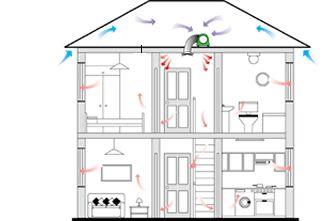 Steve from N.Ireland writes:
I'm considering installing a positivive input ventilation system like Nuaire’s Drimaster 2000? Any feedback?
Mark reckons:
Of all the varieties of ventilation systems you can fix into a building, this one has to be the worst.
Despite the rumours, positive input ventilation (PIV) like Nuaire's Drimaster (diagram above) probably won't be overlooked by the revised Part F of the E&W building regs, if only because there are a number of cases where it has been shown to work well. Usually these are on social housing schemes with condensation problems.
However, a new(ish) well-insulated house really shouldn't suffer from condensation problems. At normal relative humidity levels, the dew point is down at around 12°C and condensation won't occur at temps above this. So in this respect, it's answering a non-existent problem.
The only place where the temperature may fall below 12°C is within the roof or the external walls, so it's a good building principle to not encourage internal, moist air into these spaces. Which is exactly what PIV does.
The other major quibble with these single outlet fans (and this goes for the negative pressure fans as well) is that with just one inlet/outlet point, there is ridiculously little control over just where the air is blown or drawn from. Although the diagrams show the air gently wafting all through the house, in reality it's going to take the path of least resistance, which may be straight to or from the nearest trickle vent or badly-fitted window. The larger the house, the worse this effect will be: expect 90% of the house to remain completely unventilated.
Just compare this crude device with the heater/cooler in your car where you frequently have up to six outlets, some of them directional. I think the standard set-up of trickle vents and the odd extractor fan is preferable: they give you more control and are much more adaptable.
13 Sept 2005
Jan Kaplicky: Architect, Snob
 Why do architects have to be such snobs? They are always at it, so it would seem, deploring the “awful” and the “tasteless”, urging us to embrace wonderfully creative design and cutting-edge technology.
 The latest to stick his head above the taste parapet is Jan Kaplicky, head of Future Systems, who are best known for the media centre at Lord’s cricket ground, otherwise known as “ET’s head”. Whilst his designs may be white-hot contemporary, his social attitudes sound like they have been lifted straight from "The Importance of Being Earnest."
Here’s what Kaplicky thinks of Britain in the 21st century (writing in The Quarterly, Autumn 2005)
• “We can’t endlessly convert Victorian properties, it leads nowhere.”
• “Look at the rubbish you see on the train an hour from London: the land can’t be trashed with little boxes again and again.”
• “Who cares what dull repeats grace the hangers of M&S, when Armani and Galliano are creating cutting-edge designs.”
The stuff Kaplicky designs is fun, in an oh-so-clever, post-modern way. It’s also amazingly expensive and needs very wealthy clients to commission it. As such, I have no problems with it. I have seen his “House for a Wealthy Labour MP in Pembrokeshire” — pictured here and if you walk the Pembrokeshire coast path between Broadhaven and Nolton, or simply drive along the coast road, you can hardly miss it — and it’s truly an amazing site, especially in comparison to the very unprepossessing timber-clad shacks which are its neighbours. The locals refer to it as “The Teletubby House”: they can see the funny side of it.
Not so, Kaplicky. Just why does he have to be so pompous? I don’t hear classical musicians moaning about how awful pop music is, or poets complaining that the Sun is terribly badly written. If Kaplicky chooses to wear an Armani dressing gown in his multi-coloured greenhouse, good luck to him, but must he put down everyone who shops at M&S and lives in a “dreary box within an hour from London.” That just happens to be about 15 million people. I have no doubt that a couple of million of them, at least, would jump at the chance of living in a Future Systems house, but there are probably only a couple of hundred who could afford to. Maybe that’s Kaplicky’s real beef.
9 Sept 2005
On prices in the Housebuilder's Bible
 Matt Latter writes:
Firstly, can I congratulate you on a fantastic book for anyone who wants to understand the options when building or just improving a property. I have found your book invaluable for grasping what is technically required for a multitude of projects on my house, in order to organise any kind of contractor or even DIY work.
I have the 2002 edition of The Housebuilder's Bible and do however have a concern about general pricing. I have pretty much read your book cover to cover and have always thought that your price estimates looked very optimistic based on any quotes I've ever had from any contractors. I do try to allow for the fact that I live on the South Coast (Hampshire) and there has been quite a lot of increase in labour rates in the last 3 years, but even with this considered, I can't get estimates from any contractor even close to your tables.
A specific example is that you estimate 8 hours / £200 for a plumber to install a boiler, and 4 hours to install a cylinder. Even then, you state £25 per hour is probably too HIGH, but allows for a typical mark-up on the supplied units. I have just been quoted £3300 and £3500 by 2 plumbing firms to replace my boiler and replace my copper cylinder with a Mains pressure system. There is no primary pipework to run, just the local connection pipework to adapt, and the boiler isn't moving location so the flue vent is already there. I know I can buy the boiler (Potterton 24KW), Cylinder (Megaflo 210ltr) + flue kit for £1700 inc., so that means they're making at least £1600!!! I can't see the job taking more than 2 days, (probably more like 12 hours) including removing the old units. That says they are making £100 to £135 per hour! That's up to 5x your "generous" £25 per hour.
Other smaller plumbing job quotes also seem to reflect this ridiculous labour rate, so am I in the wrong job or am I just picking outlandishly greedy plumbers?
I've also had various quotes over the last 2 years quotes for UPVC DG, and general building work, which come in at anything from 3x your reckoning in the Bible, upwards. When I have questioned pricing, no contractor has ever agreed to reduce the price, usually insisting they'd be making a loss if they reduced it. How can a 3m stud wall with a door fitted cost £1000? !!
I notice the property developer and self-build programs on TV, and
magazines like "Build it" all quote success stories from people who "built a £300K house for £80K" or "completely renovated, extended and loft converted for £40K". I wouldn't even get close to this price for the amount of work involved in these projects based on the estimates I get.
Why is there such a disparity? Is South-East really that far out with the averages you seem to work from? Would it have something to do with me having a big house and therefore any contractor thinks we're "loaded" and therefore we won't flinch at these stupid prices?
Let me know your thoughts. Perhaps there is a formal study of the pricing in the building contractor industry across the country that can help answer my questions?
Still a great book though and better than anything else out there! Can't help think there's room for a bigger section on evaluating how "reasonable" a quote is and maybe a rolling addendum specifically to adjust prices for different areas, kept up to date.
Best Regards,
Matt Latter
Mark replies:
Thanks for the warm comments, Matt. As to your concerns, it's difficult to comment on individual quotations as I don't know the extent of the works but it does look as though your are ignoring the whole issue of the contractor's mark-up, which gets progressively larger as the job gets smaller. My labour and materials prices in the books are just that, labour and materials, and should not really be used to work out quotations. On small refurb jobs, in particular, it's quite usual for contractors to add on 50% to labour and materials to cover the "hassle factor." There may be things in the way, access may not be easy, there may be all kinds of extra work to undertake, the installation may not work as planned from day one, there are guarantees and call backs to factor in, plus the overheads of running small businesses which are significant. These are deliberately ignored in the costings in the Bible, which looks at how much it should cost to build a house, not what you would be charged for having that work carried out by a builder.
For instance, earlier this year, I replaced an ancient and knackered mains-pressure cylinder with a new 210lt Megaflo. The plumber took the best part of a day to get the new Megaflo in (there was carpentry work involved in adapting the airing cupboard), but he also took nearly four hours getting the old one out (draining down the system, adjusting the pipework). Plus he had (and needed) a mate. So when I say that a Megaflo can be put in in 4 hours (it's actually gone to 6 in the new book), it can, be but it can also take much longer.
> I notice the property developer and self-build programs on TV, and
> magazines like "Build it" all quote success stories from people who "built
> a £300K house for £80K" or "completely renovated, extended and loft
> converted for £40K". I wouldn't even get close to this price for the amount of work involved in these projects based on the estimates I get.
> Why is there such a disparity?
A combination of poor maths and ignoring soaring land prices during the duration of the job.
> Is South-East really that far out with the
> averages you seem to work from?
No. It's maybe 20% more expensive on labour rates; materials are the same nationwide.
>Would it have something to do with me
> having a big house and therefore any contractor thinks we're "loaded" and
> therefore we won't flinch at these stupid prices?
No, I don't think so, though it's surprising how many people think this. If you have got a lot of work, then perhaps you should consider hiring guys on a cost plus basis. You effectively take the risk on your own shoulders if things go wrong. The rates should be dramatically cheaper but you will find yourself in one or two contractual knots when people make cock-ups (they will) and you have to pay them twice for doing the job they should have done right first time around but didn't. Once you go to fixed price quotations, on small jobs, the price rockets. This doesn't make the tradesmen greedy; it's simply a realistic assessment of the risks taken on in giving fixed price quotations.
Subscribe to:
Comments (Atom)